
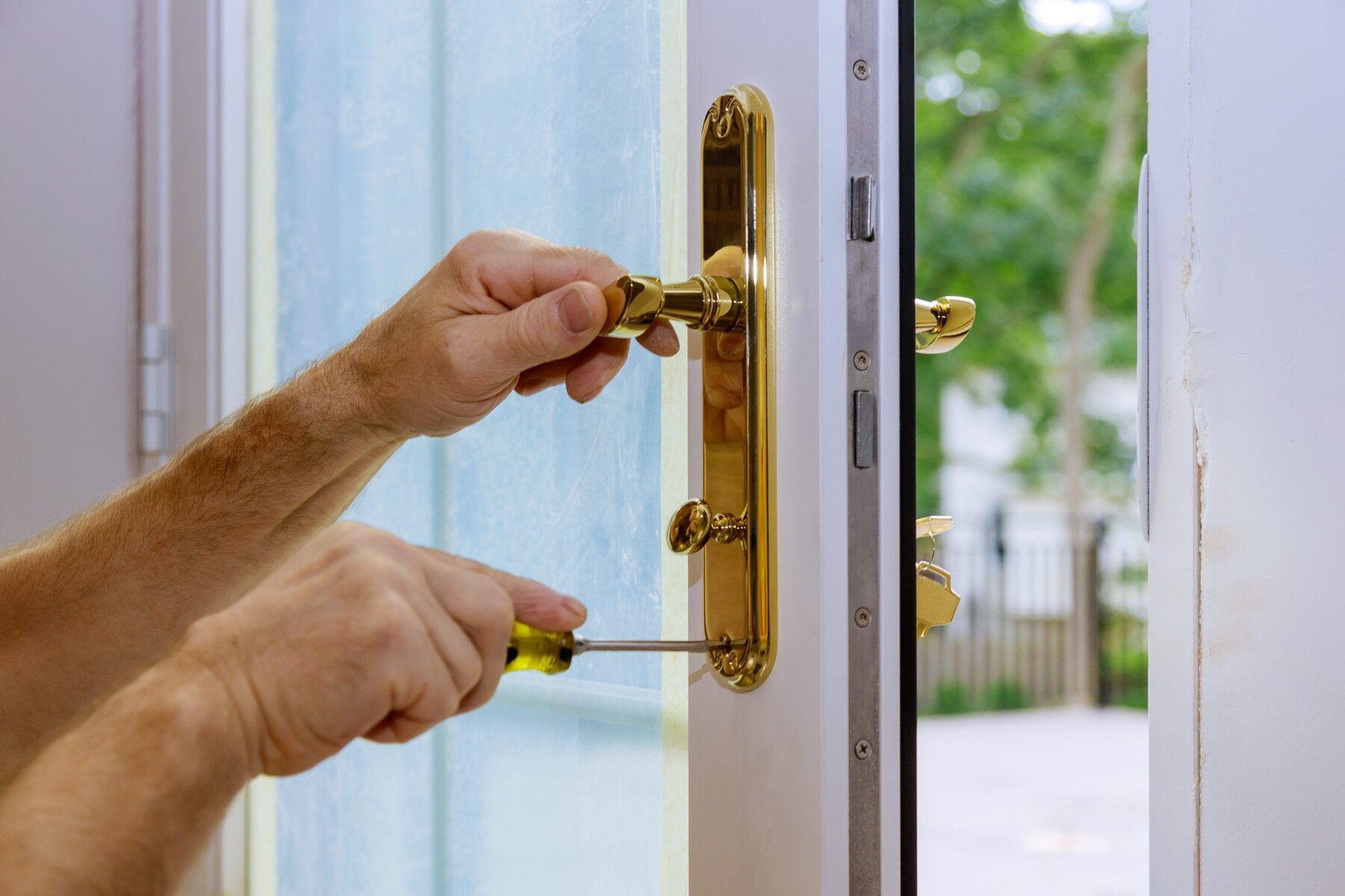
In our daily locksmith operations across Manhattan, we routinely inspect residential entry doors following forced-entry attempts. A recurring finding in these field investigations is that standard single-cylinder deadbolts rarely fail due to lock-picking or cylinder manipulation. Instead, they fail because the door frame yields under pry pressure. In multi-family apartment buildings across the Upper East Side, SoHo, Washington Heights, and Greenwich Village, aging door frames and building settlement create significant gap tolerances between the door edge and jamb. When an intruder applies a crowbar, a conventional horizontal deadbolt bolt simply slips free once the frame spreads outward by 0.5 to 0.75 inches.
An interlocking deadbolt—frequently referred to as a jimmy-proof lock, vertical dropbolt, or Segal lock—eliminates this structural vulnerability. By utilizing solid vertical steel pins that drop down through interlocking metal loops on a frame-mounted box strike, the locking assembly ties the door and frame into a unified physical structure. Any outward prying force actually pulls the interlocked loops tighter against the vertical bolts, making door-spreading attacks virtually impossible.
Table of Contents
Structural Vulnerabilities in Manhattan Residential Entry Doors
Manhattan housing stock presents distinct environmental and structural challenges that compromise standard door hardware performance:
- Seasonal humidity fluctuations from steam heat systems in winter and high summer humidity cause solid wood doors and frames to expand and shrink, creating shifting gap tolerances.
- Structural settling in pre-war brownstones and multi-family buildings leaves door jambs out of plumb, reducing horizontal bolt throw engagement depth.
- Softwood jamb casings and thin trim layers fail to anchor standard 1-inch strike screws, allowing the entire strike assembly to tear away under physical impact.
- Narrow public hallway configurations provide intruders leverage points for long pry bars against vulnerable door edges.
Under testing criteria established by the Builders Hardware Manufacturers Association (BHMA), standard ANSI Grade 2 or Grade 3 deadbolts are evaluated for face impacts, but they rely entirely on the strength of the wood jamb surrounding the latch pocket. In contrast, an interlocking deadbolt distributes physical force across heavy-duty surface plates mounted directly to the solid door core and anchored deep into structural wall studs.
Mechanical Principles of Interlocking Dropbolt Systems
Unlike tubular deadbolts that fit inside a cylindrical cross-bore pocket drilled through the edge of the door, an interlocking deadbolt operates as a surface-mounted rim locking system:
- Exterior Rim Cylinder: A key-operated cylinder passes through a 1.25-inch cross-bore hole in the door face, connecting to the internal lock assembly via a flat connecting tailpiece.
- Interlocking Mechanism: The main lock body mounts directly onto the interior surface of the door. It houses two or more solid steel pins driven vertically by an internal cam gear.
- Box Strike Housing: A heavy-duty metal strike housing attaches to the interior door frame jamb, featuring intermeshing vertical rings aligned with the lock body.
- Vertical Pin Lock Engagement: Turning the key or thumbturn drops the solid vertical steel pins down through the interlocked loops, establishing a rigid steel pin-and-hinge barrier across the door seam.
Performance Analysis of NYC Entry Lock Mechanisms
To evaluate how interlocking deadbolts perform against other hardware options common in Manhattan apartments, we compare key performance specifications in the table below:
| Lock Type | Primary Locking Axis | Forced Entry / Pry Resistance | Frame Modification Required | Frame Flex Vulnerability | Average Hardware Cost | Average Professional Installation Cost |
|---|---|---|---|---|---|---|
| Standard Tubular Deadbolt | Horizontal sliding bolt | Low to Moderate (150 to 300 lbs force) | Edge pocket mortise and 2.125-inch crossbore | High (Frame spreading disengages bolt) | 30 USD to 90 USD | 150 USD to 250 USD |
| Mortise Lock Assembly | Horizontal bolt and latch set | High (600 to 1,000+ lbs force) | Deep edge mortise cavity (3.5+ inches depth) | Moderate (Requires precise pocket alignment) | 250 USD to 600 USD | 350 USD to 700 USD |
| Interlocking Dropbolt (Jimmy-Proof) | Vertical pin drop through interlocking loops | Very High (1,200+ lbs force) | Surface mounting with 1.25-inch cylinder hole | Minimal (Prying tightens interlocked metal loops) | 80 USD to 250 USD | 200 USD to 400 USD |
| Surface Auxiliary Rim Latch | Horizontal spring latch | Low (100 to 200 lbs force) | Surface mounting on door edge | High (Latch bypass with shim or card) | 40 USD to 100 USD | 150 USD to 225 USD |
Practical Solutions for Complex Manhattan Door Assemblies
Throughout our field service in Manhattan, we frequently encounter complex structural and regulatory challenges that demand customized interlocking deadbolt installations.
Case Study 1: Frame Realignment and Masonry Anchoring in Upper West Side Cooperatives
In a pre-war cooperative building on West 86th Street, a tenant experienced repeated lock binding on a newly installed conventional deadbolt. Building settling had created a 0.625-inch gap between the door edge and the frame. A previous handyman attempted to fix this by stacking strike plate shims, leaving the horizontal bolt holding by only 0.25 inches of steel engagement.
Our Resolution: We retrofitted the door with a high-security single-cylinder interlocking deadbolt. Because the hollow metal door buck was set directly against brick masonry, standard wood screws could not achieve structural hold. We precision-cut a custom mounting shim, drilled through the hollow metal frame into the structural brick partition, and installed 3.5-inch sleeve anchors to secure the box strike. The vertical interlocking pins bridged the 0.625-inch gap completely without binding, restoring maximum physical defense and key operation.
Case Study 2: Fire Code Compliance and High-Security Retrofitting in SoHo
In a SoHo loft converted apartment, a commercial tenant had previously installed a double-cylinder interlocking lock requiring a key from both the inside and outside. During a fire safety compliance review, this hardware was flagged as a dangerous life-safety violation. The tenant needed high-security pick and drill resistance while maintaining legal emergency egress capability.
Our Resolution: We removed the double-cylinder hardware and replaced it with an ALOA-compliant single-cylinder interlocking dropbolt featuring an interior thumbturn knob. We integrated a Medeco X4 high-security rim cylinder on the exterior face. This configuration fulfilled FDNY emergency evacuation mandates while supplying patented key control and pick/drill defense certified under UL437 standards.
Professional Installation and Calibration Protocol
Installing an interlocking deadbolt requires precise measurement and template alignment. Minor miscalculations lead to lock binding, key stiffness, or complete mechanism jamming:
- Backset and Thickness Verification: Standard rim cylinders accommodate door thicknesses between 1.375 inches and 2.25 inches with standard backsets of 2.375 inches or 2.75 inches from the door edge.
- Cylinder Bore Hole Drilling: Using a specialized hole saw, we drill a clean 1.25-inch (32 mm) hole through the door face, pre-drilling from both sides to eliminate wood splintering on solid core doors or metal burring on steel-clad doors.
- Tailpiece Trimming: The flat connecting tailpiece must be trimmed using a fine-tooth hacksaw so it extends exactly 0.375 inches past the interior door surface. A tailpiece cut too long jams the internal drive cam; a tailpiece cut too short fails to engage the cylinder driver.
- Interior Backplate and Body Alignment: We secure the steel interior mounting backplate, slide the lock body over the cylinder tailpiece, and test key rotations before driving final anchor screws.
- Box Strike Alignment and Frame Anchoring: The box strike must be positioned on the frame casing so the vertical pins pass through the interlocking loops with zero friction. We replace standard trim screws with 3-inch hardened steel wood screws that penetrate through the jamb casing into the structural wall framing.
New York City Municipal Regulations, Legal Rights, and Egress Rules
Understanding municipal regulations is vital before altering residential lock hardware in New York City:
- Tenant Rights to Install Locks: Under New York Multiple Dwelling Law Section 51-C and the NYC Housing Maintenance Code (NYC Administrative Code Section 27-2043), tenants in multi-family buildings hold the legal right to install an additional lock on their entrance door at their own expense, provided a duplicate key is furnished to the landlord upon reasonable request.
- Fire Safety Emergency Egress Regulations: The NYC Fire Code strictly prohibits double-cylinder deadbolts (locks requiring a key to exit from the inside) on primary residential exit doors. Every residential entrance door must permit single-motion egress via an interior thumbturn knob without keys or special knowledge, matching safety guidelines supported by the ALOA Security Professionals Association.
- Building and Historic Preservation Rules: While state law protects tenant lock rights, installing hardware that damages historic exterior door facades in designated landmark districts may require co-op board review or specific trim matching.
Hardware Selection, High-Security Cylinders, and Smart Integration
Selecting high-grade lock components ensures durable physical security and smooth everyday operation:
- Material Specifications: Avoid cheap die-cast zinc or aluminum alloy dropbolts found in standard hardware retail stores. Select dropbolts manufactured from solid bronze, ductile iron, or drop-forged solid steel (such as original Segal, Marks USA, or Mul-T-Lock hardware).
- High-Security Cylinder Upgrades: Standard original rim cylinders can be upgraded with high-security replacement cylinders featuring restricted keyways, sidebars, and hardened steel drill inserts. High-security cylinders like Medeco, Mul-T-Lock MT5+, and Abloy prevent unauthorized key duplication at kiosks.
- Comprehensive Cost Breakdown: Commercial-grade interlocking lock sets range from 80 USD to 250 USD for hardware components. Professional installation labor in Manhattan typically costs between 200 USD and 400 USD depending on whether frame reinforcement or masonry anchoring is required. Total installation investment averages 280 USD to 650 USD.
- Smart Lock Compatibility Solutions: Motorized consumer smart locks are engineered primarily for horizontal tubular deadbolts and are mechanically incompatible with surface-mounted vertical dropbolts. Property owners desiring keyless convenience can pair an interlocking deadbolt with a specialized electronic smart rim cylinder or install a smart deadbolt as a primary latch alongside a secondary mechanical interlocking dropbolt.
Frequently Asked Questions
Is an interlocking deadbolt legal for apartment tenants in NYC?
Yes. Under New York Multiple Dwelling Law Section 51-C, tenants in multi-family residential buildings have the legal right to install an additional lock on their apartment entry door. However, the tenant must provide a duplicate key to the landlord or property management upon request.
What is the difference between a single-cylinder and double-cylinder interlocking deadbolt?
A single-cylinder interlocking deadbolt features a key cylinder on the outside and an easy-turn thumbturn knob on the inside. A double-cylinder version requires a key to operate the lock from both sides. In New York City, double-cylinder locks on primary residential egress doors violate NYC Fire Code regulations because they hinder emergency evacuation.
Can an interlocking deadbolt be installed on a hollow metal or steel door frame?
Yes. Installing an interlocking deadbolt on hollow metal frames is common in NYC apartment buildings. Professional installation requires blind rivet nuts, metal thread fasteners, or long anchor bolts driven through the hollow metal frame buck into the structural wall framing or masonry studs behind the jamb.
How does an interlocking deadbolt prevent door-prying or jimmying break-in attempts?
Standard deadbolts rely on a horizontal bolt resting inside a frame recess, which can slip out if a pry bar spreads the door frame outward. Interlocking deadbolts use vertical steel pins that drop down through interlocking metal loops on the strike plate. Prying the door outward forces the metal loops tighter against the vertical steel pins, keeping the door secured.
Can smart lock technology be combined with an interlocking deadbolt system?
While standard electronic smart deadbolt assemblies do not directly drive vertical dropbolt mechanisms, specialized smart rim cylinders can replace the exterior key cylinder. Alternatively, homeowners often maintain a mechanical interlocking deadbolt for primary high-security physical defense alongside a primary smart lock for keyless access control.
Sources
- New York State Multiple Dwelling Law, Section 51-C: Rights of Tenants to Install and Maintain Locks in Certain Entrance Doors.
- New York City Administrative Code, Section 27-2043: Locks in Dwelling Unit Doors (NYC Housing Maintenance Code).
- NYC Fire Code Section 1010.1 & Building Code Regulations regarding Single-Motion Emergency Egress.
- Builders Hardware Manufacturers Association (BHMA) / ANSI A156.36 Standards for Auxiliary Locks and Deadbolts.
- ALOA Security Professionals Association: Professional Hardware Installation Guidelines and Life Safety Egress Compliance.
Related Articles
People Also Ask
For a standard deadbolt installation in Manhattan, professional locksmiths typically charge between $80 and $200. This price range includes the cost of a quality deadbolt (usually $30 to $60) and the labor fee, which can vary based on the door material and complexity of the job. For a simple replacement on a standard wooden door, you can expect to pay on the lower end. However, if the door requires drilling or has a metal frame, the cost may increase. To ensure you get a fair price and proper installation, always request an upfront estimate. For specific guidance on securing your property after a tenancy change, please refer to our internal article Changing Locks After A Tenant Moves Out In NYC. ALO Locksmith Services Manhattan NYC recommends always hiring a licensed professional to guarantee security and warranty.
Yes, in New York City, landlords are legally required to change or rekey the locks between tenancies. This is mandated by the New York City Housing Maintenance Code (Section 27-2031), which states that the owner must provide and maintain locks that ensure the dwelling is secure. After a tenant moves out, the previous tenant may have made copies of the keys, posing a security risk. To comply with the law and protect the new tenant, the landlord must replace the lock cylinder or rekey the existing lock. For professional advice on securing your property during these transitions, ALO Locksmith Services Manhattan NYC recommends reviewing our internal article titled 'Risks Of Subletting Your NYC Apartment And How To Secure It' Risks Of Subletting Your NYC Apartment And How To Secure It.
An interlocking deadbolt is a high-security locking mechanism that uses a vertical bolt system to lock the door into the frame at multiple points. Unlike a standard deadbolt, which extends a single horizontal bolt into the strike plate, an interlocking deadbolt features a hook-shaped or claw-like bolt that engages with a reinforced strike plate on the door jamb. This design creates a much stronger connection, making it extremely difficult for intruders to force the door open with tools like crowbars or kick-in attacks. For Manhattan residents seeking enhanced security, this is a robust option. For a deeper comparison of security upgrades, consider reading our internal article titled 'High-Security Vs. Smart Locks: Which Is Right For Your NYC Condo?' at High-Security Vs. Smart Locks: Which Is Right For Your NYC Condo?.
Yes, you can add a deadbolt to a door that doesn't have one, but it requires careful planning and proper installation. The process involves drilling a large hole for the deadbolt body and a smaller one for the latch, which can weaken the door if not done correctly. For wooden doors, you must ensure the door is thick enough (typically at least 1 3/8 inches) and that the frame is reinforced to support the added security. Steel or fiberglass doors may need specialized tools. A professional locksmith can assess your door's condition and install a high-security deadbolt without compromising its integrity. For comprehensive guidance, refer to our internal article titled Securing Your Office Door With Grade 1 Locks In Manhattan, which covers best practices for upgrading office security. ALO Locksmith Services Manhattan NYC recommends consulting a licensed technician to avoid voiding warranties or creating vulnerabilities.
For Manhattan homeowners, an interlocking deadbolt is a high-security lock that physically connects the deadbolt to the door frame, making it extremely resistant to kick-in attacks. This mechanism uses a horizontal bolt that slides into a reinforced strike plate, creating a stronger bond than a standard deadbolt. When considering installation for your Manhattan residence, professional assessment is crucial to ensure the door and frame can accommodate the lock's specifications. For a detailed breakdown of how this system works and whether it suits your security needs, we recommend reviewing our internal article titled What Is An Interlocking Deadbolt And Do You Need One?. ALO Locksmith Services Manhattan NYC always advises consulting a certified technician to verify compatibility with your specific door type and building regulations.
The cost of installing an interlocking deadbolt for your Manhattan home varies based on door type, lock brand, and labor complexity. On average, professional installation ranges from $150 to $350, with high-security models costing more. Interlocking deadbolts provide superior protection by embedding a steel bolt into the door frame, making them highly resistant to kick-ins and forced entry. For a detailed breakdown of how this system works and whether it suits your security needs, please refer to our internal article titled What Is An Interlocking Deadbolt And Do You Need One?. ALO Locksmith Services Manhattan NYC recommends assessing your door's condition and frame alignment before installation to ensure optimal performance and longevity.
