
When Your Car Won’t Start: The Real Story Behind Ignition Problems In Washington Heights
When a vehicle fails to start along the steep avenues of Washington Heights, drivers usually assume they have a dead battery, but mechanical wear, electrical contact degradation, and transponder chip miscommunication drive most failures in our field experience. Isolating these three distinct operational layers on-site allows us to prevent unnecessary starter replacements, expensive flatbed towing, and severe municipal parking fines.
We frequently assist stranded motorists in Manhattan who have replaced functional batteries and starters only to find their vehicle still refuses to crank. Modern automotive ignition setups rely on three distinct operational layers that must execute in perfect synchronization before fuel injection occurs. A mechanical binding in the lock barrel, thermal fatigue inside the electrical switch, or a corrupted anti-theft key code will halt engine starting.
- An automotive ignition system operates across three distinct sub-assemblies: mechanical key validation, high-current electrical switching, and passive radio-frequency anti-theft authorization.
- A depleted battery typically causes rapid solenoid clicking and severe interior light dimming, while a failed ignition switch retains full accessory illumination while severing relay activation voltage.
- Parallel parking on steep Washington Heights inclines places continuous lateral strain on the internal steering lock pin, frequently inducing severe mechanical key jamming.
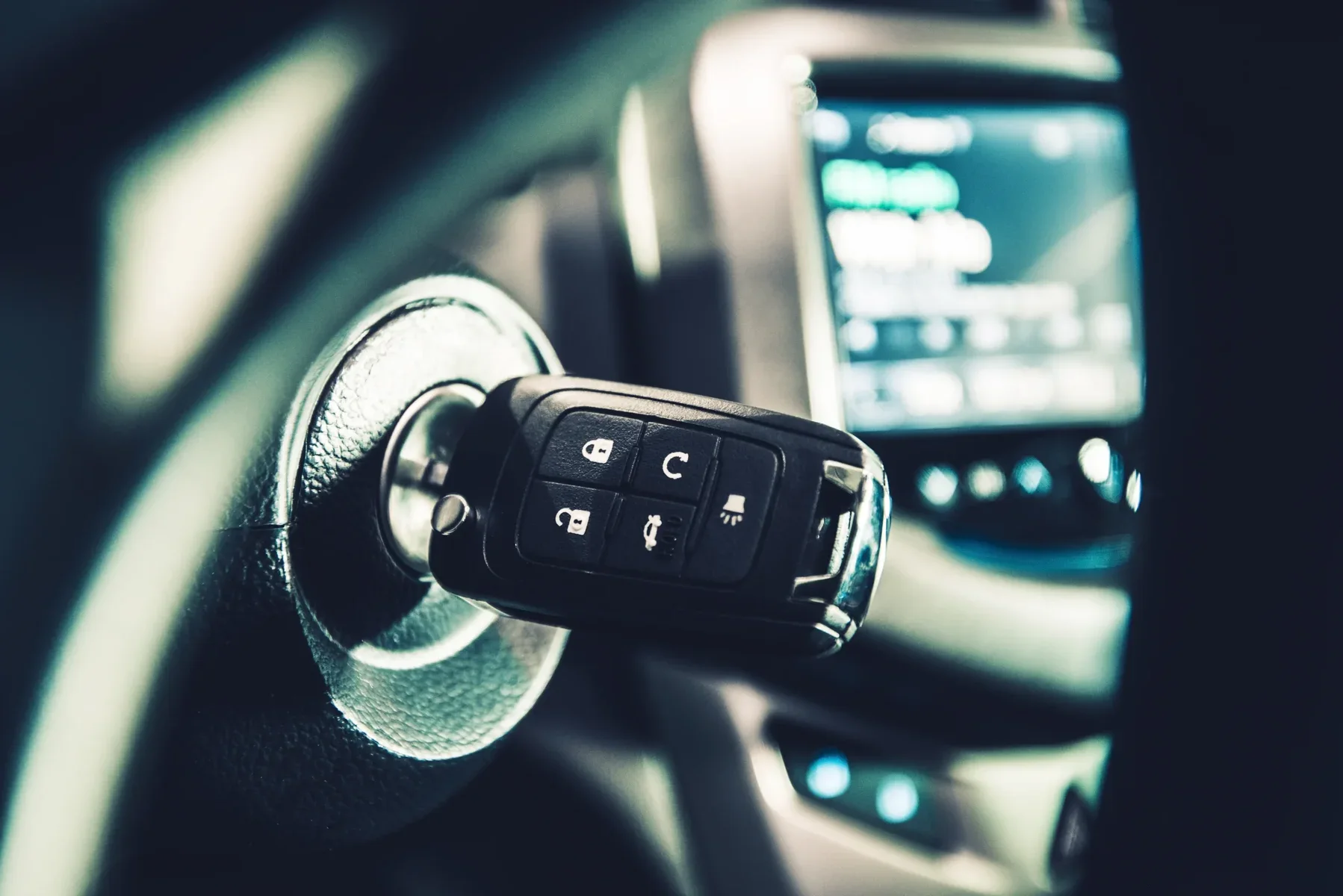
- Modern key fobs utilize passive RFID transponders that must transmit authorization codes to an antenna ring before the engine control module allows fuel delivery.
Mechanical vs. Electrical Ignition Failures: Pinpointing the Root Cause
Diagnosing automotive starting failures requires us to systematically isolate mechanical key rotation from high-current electrical circuit connectivity within the steering column housing. We independently test mechanical lock cylinders, electrical contact switches, and anti-theft immobilizer modules on-site to pinpoint exact failure points before replacing components.
In our mobile workshop operations, we approach ignition troubleshooting by separating physical rotational motion from electrical voltage delivery. Drivers seeking technical context regarding starting circuits can consult Wikipedia’s overview of automotive ignition systems for baseline engineering definitions. Mechanical components wear down through physical friction and keychain weight, while electrical assemblies degrade under thermal stress and continuous current spikes. Isolating these subsystems on-site ensures accurate repairs without throwing unnecessary replacement parts at the vehicle.
Mechanical Ignition Lock Cylinder Failures
Mechanical ignition lock cylinder failures stem from worn internal brass wafers, deformed key blades, and binding steering lock pins that physically impede key blade rotation. Over years of daily driving in Manhattan, heavy key chains and mechanical friction degrade wafer geometry until internal cuts no longer align properly with shear lines.
When internal tumblers suffer severe mechanical wear, the key blade may slide into the keyway but refuse to turn toward accessory or run positions. In other cases we encounter across Upper Manhattan, keys become trapped inside the lock barrel due to broken wafer retaining springs. High ambient urban humidity and seasonal road salt exposure further accelerate internal oxidation and binding inside steering column housings.
Electrical Ignition Switch Failures
Electrical ignition switch failures occur when internal copper contacts suffer severe thermal fatigue, plastic housing warping, or excessive carbon buildup from arcing high-amperage starting current. When these internal contacts break down, the electrical switch fails to send necessary signal voltage to starter relays or maintain continuous current feed to engine controllers.
A compromised electrical switch typically manifests through intermittent engine stalling over rough street surfaces, complete crank silence, or sudden instrument cluster blackout. During physical teardowns, our technicians regularly observe melted plastic housings, weakened contact return springs, and severe carbonization across copper contacts inside the switch housing. These electrical faults cut power to essential fuel relays even while the mechanical key turns freely.
Transponder and Anti-Theft Immobilizer Malfunctions
Transponder and anti-theft immobilizer malfunctions happen when radio-frequency communication fails between encrypted key fob microchips, antenna ring coils wrapped around lock cylinders, and engine control units. If security validation fails, engine control modules instantly disrupt fuel injector pulses or disable starter relays, blocking the vehicle from starting.
Vehicles manufactured over the past two decades integrate these passive anti-theft security systems to prevent physical bypass attempts. When a key fob transponder chip suffers internal circuit damage or the antenna receiver coil loses wiring continuity, engine cranking becomes unstable. The engine may fire briefly for one second before shutting down completely while displaying a security indicator light on the dashboard.
Diagnostic Matrix: Identifying the Failure Component
To pinpoint specific ignition failures efficiently, our diagnostic matrix categorizes common vehicle symptoms alongside primary suspect components, secondary causes, and mobile field testing procedures. Utilizing structured signal tracing, digital multimeter voltage tests, and diagnostic scanner data streams allows us to differentiate between physical binding, electrical switch failure, and security system lockouts.
| Symptom Observed | Primary Suspect Component | Secondary Potential Cause | Diagnostic Verification Method |
|---|---|---|---|
| Key turns smoothly, dashboard lights illuminate, zero crank or solenoid click | Electrical Ignition Switch | Neutral Safety Switch / Starter Relay | Test terminal 50 signal voltage at starter relay while holding key in Crank position |
| Key inserted but physically locked and will not rotate toward ACC or ON | Mechanical Lock Cylinder | Bound Steering Column Lock Pin | Wiggle steering wheel left to right while applying light rotational torque to key |
| Engine cranks vigorously but refuses to catch or fire | Immobilizer Transponder / Ignition Switch | Fuel Pump Relay / Crankshaft Sensor | Scan Engine Control Module for anti-theft DTC fault codes |
| Engine starts, runs for 1 to 2 seconds, then immediately shuts down | Key Fob Transponder Chip | Immobilizer Receiver Antenna Ring | Test ignition with master mechanical spare key; inspect dash for flashing security icon |
| Key turns and starter operates, but power cuts completely upon key release to RUN | Ignition Switch Contact Springs | Main Power Supply Relay | Probe ignition circuit feed wire for continuous 12-volt current in RUN position |
Real-World Case Studies: Resolving Complex Ignition Failures in Upper Manhattan
Resolving complex vehicle starting failures in Upper Manhattan requires specialized field expertise tailored to dense urban environments, steep roadway inclines, and challenging physical parking positions. We document actual field dispatches across Washington Heights where our mobile response teams executed immediate on-site mechanical and electrical repairs, resolving severe lockouts without towing.
Case Study 1: Mechanical Steering Lock Binding on Fort Washington Avenue
Emergency calls along Fort Washington Avenue frequently involve severe mechanical steering column lock binding caused by parking heavily loaded front wheels tightly against high concrete curbs on steep grades. When extreme lateral forces pin steering shafts against internal cylinder locking pins, key rotation becomes jammed, requiring physical load relief before tumbler servicing.
Our dispatch team arrived on Fort Washington Avenue near Fort Tryon Park to service a trapped Honda Accord during an active street cleaning enforcement window. The vehicle owner turned front tires hard into the curb, creating severe directional load on the steering column locking pin. In a desperate attempt to free the lock, the driver used locking pliers, twisting the mechanical bow of the key blade and damaging internal top tumblers. We utilized hydraulic alignment wedges to relieve mechanical force off the front steering rack while carefully neutralizing column torque.
Once lock pin pressure was relieved, our technician extracted the jammed cylinder, replaced damaged internal wafers, re-keyed the assembly to match original door locks, and cut a fresh high-security laser key on-site within 45 minutes. This on-site resolution saved the driver 250 US Dollars in towing charges and avoided municipal impound fees.
Case Study 2: Intermittent Anti-Theft Lockout on 181st Street
Intermittent anti-theft lockouts along 181st Street near Broadway often stem from fractured wiring harnesses subjected to continuous road vibration rather than failed starter motors or depleted batteries. Diagnosing these intermittent security lockouts demands real-time scanner data analysis and signal wire resistance probing rather than randomly replacing operational electronic components.
We received a service request for a Chevrolet Malibu parked along 181st Street that suffered unpredictable non-start episodes over two weeks. The owner had already spent over 600 US Dollars replacing functional batteries and starters at local shops without solving the root issue. Connecting our diagnostic equipment revealed active security system fault codes pointing to signal voltage instability.
We inspected the steering column wiring loom and discovered micro-fractures inside the security sensor signal wire bundle, caused by continuous vibration from rough road conditions along Broadway. Our technicians repaired the damaged wiring harness, calibrated sensor signal voltage thresholds, and completed an engine control module relearn procedure on-site, fully restoring starting reliability without replacing major electronic modules.
Navigating Washington Heights Conditions: Urban Logistics and On-Site Repairs
Operating vehicles in Washington Heights presents severe urban parking challenges, steep avenue topographies, and strict municipal regulations that directly impact emergency ignition repair decisions. Drivers experiencing starting issues must navigate rapid enforcement of city parking rules alongside physical tow truck clearance limitations across tight residential blocks.
Drivers encountering starting issues must review NYC 311 Alternate Side Parking regulations to prevent immediate municipal towing while waiting for diagnostic service. Dense residential blocks make flatbed towing nearly impossible, placing a premium on mobile lock cylinder extraction and on-site module programming. We structure our mobile repair units to navigate steep grades and narrow street clearances throughout Upper Manhattan efficiently.
- Strict Alternate Side Parking Enforcement: Street sweeping schedules across Manhattan are rigidly enforced, where leaving a non-running vehicle on restricted curbs risks a 65 US Dollars parking fine plus immediate city impound towing.
- Tight Parallel Towing Limitations: Extracting non-operational vehicles with locked steering shafts from narrow parallel parking spaces along Cabrini Boulevard or Pinehurst Avenue presents severe physical obstacles for flatbed tow trucks.
- Environmental Stress Factors: Prolonged exposure to intense summer heat trapped inside enclosed steering columns causes electrical switch housings to warp, while winter road salts accelerate internal lock barrel corrosion.
- Inclined Parking Forces: Habitual angle parking on steep Upper Manhattan grades maintains constant mechanical side-load on steering column lock pins, accelerating physical tumbler wear.
Comprehensive Ignition Repair and Replacement Cost Breakdown
Understanding detailed cost breakdowns for ignition lock cylinder replacements, electrical switch installations, and transponder programming helps drivers evaluate mobile locksmith service estimates accurately. According to repair data from RepairPal, typical ignition switch replacement costs range between 244 US Dollars and 315 US Dollars depending on labor complexity and vehicle design.
| Service Category | Typical Cost Range (USD) | Mechanical / Electrical Components Involved | Average Labor Time |
|---|---|---|---|
| Simple Key Extraction (Stuck/Unbroken) | 75 USD to 150 USD | Steering wheel lock pressure release, cylinder lubrication, wafer alignment | 20 to 30 Minutes |
| Broken Key Extraction & Blade Cutting | 125 USD to 275 USD | Broken fragment extraction, mechanical code reading, new blade cutting | 30 to 60 Minutes |
| Ignition Lock Cylinder Replacement | 185 USD to 425 USD | Physical lock barrel replacement, custom wafer re-keying to match existing vehicle doors | 1 to 2 Hours |
| Electrical Ignition Switch Replacement | 195 USD to 450 USD | Steering column shroud disassembly, wiring harness terminal testing, switch replacement | 1 to 1.5 Hours |
| Transponder Key / Fob Programming | 120 USD to 300 USD | EEPROM / OBD-II port diagnostics, RFID chip generation, ECM synchronization | 30 to 45 Minutes |
| Complete Ignition Column Rebuild | 450 USD to 1,200 USD | Lock cylinder, electrical switch, immobilizer receiver ring, and steering lock assembly | 2 to 4 Hours |
Step-by-Step Diagnostic Protocol Before Calling for On-Site Support
Executing a systematic preliminary diagnostic protocol before requesting mobile professional assistance helps isolate simple operational obstacles from severe mechanical lock cylinder or electrical switch failures. We recommend that drivers in Washington Heights perform five specific sequential checks to determine whether on-site locksmith repair or electrical dispatch is needed.
- Verify Electrical System Load via Headlight Testing: Turn on vehicle headlights and attempt to crank the engine to observe light intensity changes. If headlights remain fully illuminated while turning the key to CRANK, the battery holds sufficient charge, directing diagnosis toward ignition switches or starter circuits.
- Relieve Steering Wheel Mechanical Tension: Firmly pull the steering wheel left and right while applying gentle rotational pressure on the key blade. Relieving tire pressure against steep curbs will disengage locked column pins and allow the key barrel to rotate freely.
- Test Spare Transponder Key Validation: Attempt to start the vehicle using a factory master spare key if the engine cranks without firing or displays a security icon. This test confirms whether starting issues stem from damaged key fob microchips or internal anti-theft receiver coils.
- Shift Transmission Gear Positions: Place automatic transmission shift levers into NEUTRAL and attempt engine starting while pressing the brake pedal firmly. A worn neutral safety switch can interrupt circuit signals sent between the ignition switch and starter solenoid.
- Eliminate Excessive Key Ring Weight: Remove heavy key chains, heavy metal tools, and decorative accessories attached to your ignition key. Excess hanging weight pulls keys out of axial alignment inside the cylinder, causing severe tumbler jamming.
Frequently Asked Questions
Navigating unexpected vehicle starting failures requires clear technical answers before requesting professional on-site locksmith assistance in Manhattan. We compiled direct technical responses to the five most common ignition repair inquiries from drivers across Washington Heights, covering electrical switch diagnosis, stuck keys, lock cylinder re-keying, immobilizers, and urban dispatch logistics.
How can we tell if an ignition switch is bad versus a dead battery?
A bad electrical ignition switch typically keeps accessory lights powered while producing total silence in the CRANK position, whereas a depleted battery causes rapid solenoid clicking and severe dash illumination dimming. In our field diagnostic routine, we measure terminal output voltages across starter signal connections to verify contact integrity. If dashboard displays flicker intermittently while driving over street bumps, electrical switch contact degradation is highly probable.
Why does a car key get stuck in the ignition and refuse to turn?
A car key gets stuck in the ignition primarily due to worn internal tumbler wafers, binding steering column lock pins, or bent key blades. On steep inclines across Washington Heights, front tires pressed against curbs transmit intense mechanical torque into the steering lock shaft, wedging the locking pin tightly against the cylinder. Rocking the steering wheel left and right while applying light rotational pressure on the key blade usually releases this tension safely.
Can an ignition cylinder be replaced without changing the original car key?
Yes, a replacement ignition cylinder can be custom re-keyed on-site to match your vehicle’s original door key pattern. We reconfigure the internal brass wafer stack inside the replacement lock cylinder so that your existing physical key operates both the ignition and door locks. This process eliminates the hassle of carrying separate keys for door entry and engine starting.
What causes an anti-theft immobilizer system to block a vehicle from starting?
An anti-theft immobilizer blocks engine starting when radio-frequency communication fails between key fob microchips and steering column receiver coils. Common underlying root causes include damaged RFID fob chips, cracked antenna ring wiring around the ignition lock, or desynchronized security data inside the engine control module. When security authorization fails, the engine control unit instantly cuts fuel injection or disables starter grounding.
Is mobile on-site ignition repair better than towing a car to a repair shop?
Mobile on-site ignition repair is significantly faster and less expensive than towing a non-running vehicle through Manhattan traffic. Parallel street parking spaces and low-clearance garage spaces in Washington Heights frequently prevent flatbed tow truck maneuverability without risking bumper damage. Our mobile response team completes lock cylinder extraction, switch replacement, and key programming directly at your parked location.
Sources
- Wikipedia Technical Overview of Automotive Ignition Systems: https://en.wikipedia.org/wiki/Ignition_system
- RepairPal Ignition Switch Replacement Cost Estimator: https://repairpal.com/estimator/ignition-switch-replacement-cost
- NYC 311 Alternate Side Parking Regulations: https://portal.311.nyc.gov/article/?kanumber=KA-01011
