
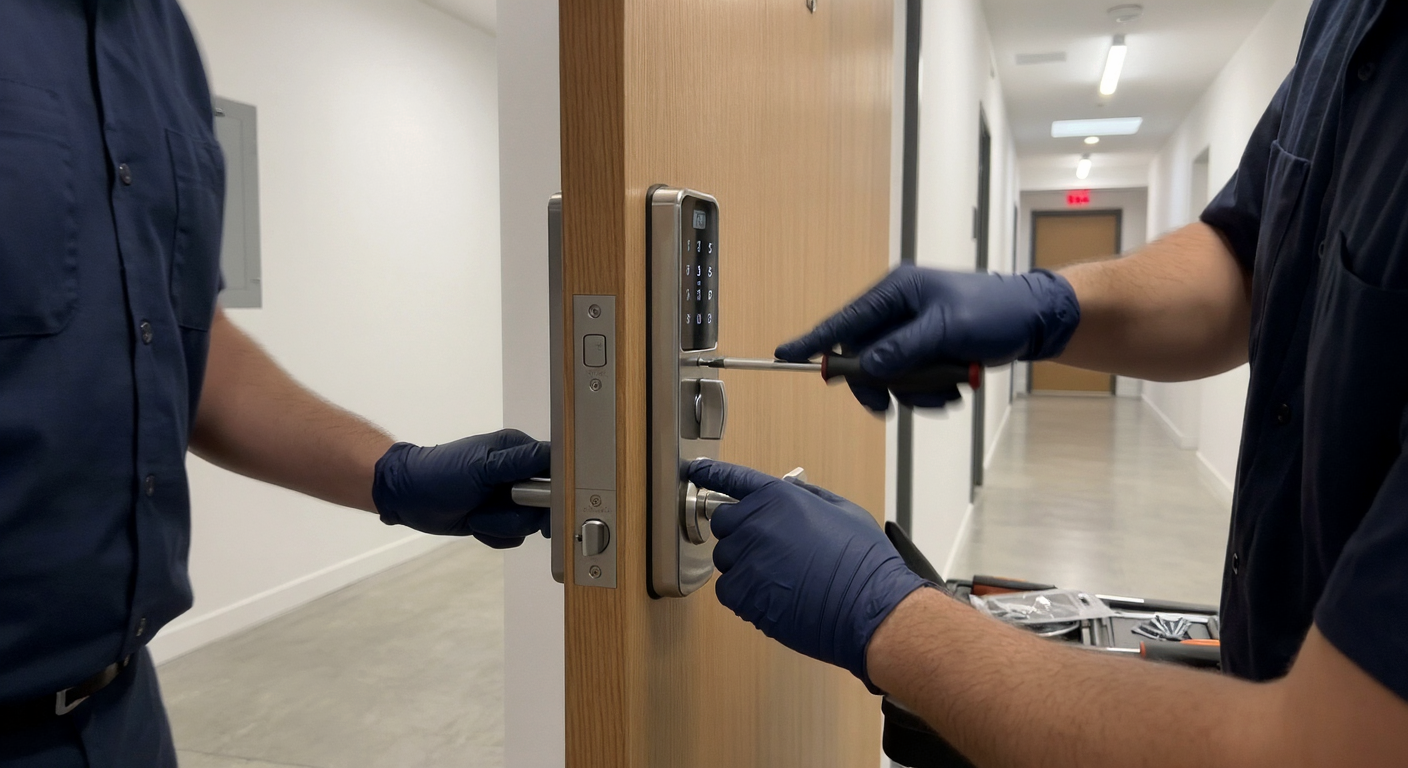
Upgrading apartment door security in New York City requires navigating complex structural hardware, rigid municipal regulations, and strict building management rules. Professional smart lock installation across Manhattan, Brooklyn, Queens, the Bronx, and Staten Island typically costs between 150 USD and 350 USD in labor fees, with specialized electronic hardware ranging from 120 USD to over 600 USD. As licensed locksmiths and physical security specialists operating across all five boroughs, we encounter unique installation challenges daily—ranging from heavy pre-war cast-iron mortise locksets to solid-core hollow-metal fire doors. Whether managing rental lease compliance under local housing laws or integrating Apple HomeKey into a high-rise luxury condo, achieving reliable keyless entry demands technical precision, appropriate hardware selection, and absolute adherence to life-safety standards.
Table of Contents
Understanding NYC Apartment Door Architecture: Mortise vs. Cylindrical Locks
Entry doors across New York City feature structural designs that differ significantly from standard suburban wooden doors. Installing keyless entry systems in NYC requires identifying the specific lock mechanism and frame construction installed on the door.
Mortise Locksets vs. Standard Tubular Deadbolts
- Pre-War Mortise Systems: Pre-war residential buildings and high-end residential towers across NYC predominantly feature mortise locks. These heavy-duty, rectangular steel lock bodies are inset directly inside a pocket carved into the edge of the door leaf. A single faceplate houses both a latchbolt operated by an interior handle and a heavy deadbolt operated by a key cylinder. Standard consumer smart locks cannot directly replace a mortise lock without specialized mounting plates, retrofit cylinders, or commercial-grade smart mortise hardware.
- Post-War Cylindrical Setups: Post-war developments and renovated brownstones frequently utilize standard cylindrical deadbolts. These sit in two distinct circular bore holes drilled through the face of the door—one dedicated to the door handle and one dedicated to the deadbolt. These doors accommodate standard smart deadbolts and retrofit interior thumbturn drives.
- Steel-Clad Fire Doors: Multi-family residential buildings in NYC rely heavily on steel-clad and solid-core fire doors set within steel door jambs. Drilling into or altering these frames requires specialized tools and technical expertise to prevent weakening the fire resistance rating or misaligning the locking mechanism.
Key Hardware Specifications for NYC Smart Lock Integration
- Backset Measurement: Standard residential doors use either a 2-3/8 inch or 2-3/4 inch backset, measured from the edge of the door to the center of the key cylinder hole. Mortise locks in older NYC buildings often feature non-standard backset dimensions, such as 2-1/2 inches or custom offsets, which must be measured prior to selecting hardware.
- Door Thickness Dimensions: Standard interior and exterior residential doors measure 1-3/8 inches to 1-3/4 inches thick. Commercial steel entry doors in high-density NYC buildings routinely measure 2 inches to 2-1/4 inches thick, requiring drive tailpiece extensions and longer mounting bolts.
- Tailpiece Alignment and Torque: Retrofit smart lock adapters attach directly to the tailpiece extending from the exterior key cylinder. Flat horizontal, vertical, and diagonal tailpieces require exact mechanical alignment to ensure the motor operates without internal friction or binding.
Real-World Case Studies: Resolving Complex NYC Smart Lock Installation Challenges
Over decades of field service, our installation team has resolved intricate architectural and regulatory security obstacles. Below are two real-world examples demonstrating how we solved complex installation scenarios in NYC properties.
Case Study 1: Resolving Latch Binding on a Settled Pre-War Door in Park Slope
During an installation in a 1920s Park Slope brownstone, a client requested a smart lock upgrade for a solid wood entry door. The door had shifted within a settled timber frame, causing significant friction when extending the deadbolt manually. A DIY attempt to install a motor-driven retrofit lock failed immediately, draining the smart lock batteries within four days and continuously throwing alignment error codes.
To resolve this issue, we performed the following procedure:
- Frame Realignment: We adjusted the heavy brass hinges using precision shims to lift the door leaf 1/8 of an inch, restoring parallel alignment between the door edge and the frame jamb.
- Mortise Strike Plate Adjustment: Rather than carving into the original historic trim, we removed the strike plate, milled the internal receiving pocket in the door frame by 3/16 of an inch, and installed an adjustable lip strike plate.
- Backset Calibration: We adjusted the tailpiece depth to eliminate mechanical play between the cylinder and the smart drive motor.
This recalibration eliminated all mechanical friction, reducing motor drag and extending battery life to its normal twelve-month operating cycle while preserving the original historical door structure.
Case Study 2: Co-Op Board Compliance and Mortise Integration in Midtown
In a luxury high-rise near Midtown Manhattan, a condo owner wanted keyless entry capabilities via Apple HomeKey. The building co-op board maintained strict policies: exterior architectural hardware could not be modified, fire ratings under NFPA rules had to remain intact, and building management required master key physical override access for emergencies. The door featured an integrated heavy-duty commercial mortise lock set within a 90-minute fire-rated steel door.
Our solution involved the following steps:
- Hardware Selection: We specified a commercial-grade smart mortise cylinder conversion system rated under UL standards for fire door assemblies.
- Keying Integration: We re-keyed the smart cylinder to match the building’s existing high-security master key system, allowing emergency management access while granting the resident encrypted digital control.
- Single-Motion Egress Verification: We verified that turning the interior lever retracted both the latchbolt and the deadbolt simultaneously in one fluid movement, maintaining full code compliance.
The co-op board approved the installation, the fire rating was fully preserved, and the owner achieved full smart access without altering the building’s exterior aesthetic.
Navigating NYC Building Codes, Lease Compliance, and Fire Safety
Modifying an entry lock on a multi-family apartment door involves strict legal and safety parameters enforced by local municipal housing authorities and national life-safety organizations.
Tenant Rights and NYC Administrative Code Section 27-2043
- Legal Tenant Right to Install Locks: According to regulations enforced by NYC Housing Preservation and Development (HPD) under Administrative Code Section 27-2043, tenants in Class A multiple dwellings have the legal right to install an additional lock on their apartment entrance door, provided they supply the landlord or property management with a functional duplicate key upon request.
- Mandatory Management Override Access: Installing an electronic keyless lock that eliminates physical key access entirely—without granting management an administrative key override or master passkey—violates municipal housing mandates and standard residential lease agreements.
- Non-Destructive Renter Solutions: Non-destructive retrofit smart locks allow renters to retain the existing exterior mechanical cylinder, keyway, and decorative hardware. This preserves the building’s existing keying setup while permitting complete reversal back to original hardware upon lease termination.
Fire Safety Regulations and Life Safety Egress Rules
- National and Local Fire Standards: Structural door modifications must comply with fire safety codes established by local authorities and the National Fire Protection Association (NFPA) under NFPA 80 and NFPA 101 standards.
- Single-Motion Egress Standard: NYC building and fire codes require that turning the primary interior door lever or thumbturn must retract both the latch and the deadbolt simultaneously in one single rotational motion. Smart locks installed on primary exit doors must permit instant manual unlatching from the interior without requiring battery power, electronic credentials, or multi-step manual turning.
- Fire Door Integrity Certifications: Smart lock hardware installed on fire-rated solid-core or steel doors must carry appropriate certifications from Underwriters Laboratories (UL), such as UL 10C standard testing for positive pressure fire tests of door assemblies. Modifying or drilling unapproved holes into a fire door can invalidate its fire rating and trigger municipal code violations ranging from 800 USD to 5000 USD.
Comprehensive Smart Lock Hardware Matrix for NYC Residences
Selecting appropriate keyless lock hardware depends on the door mechanism, building occupancy status, and wireless network protocol.
| Smart Lock Category | Compatible Door Mechanism | Lease / Rental Compatibility | Connectivity Protocols | Recommended US Brands | Security & Fire Grade |
|---|---|---|---|---|---|
| Retrofit Interior Smart Drives | Standard Cylindrical Deadbolts, Select Mortise Locks | High (100 Percent Non-Destructive) | Bluetooth, Wi-Fi, Matter, Thread | August, Yale | Retains Existing Mechanical Hardware Grade |
| Electronic Keypad Deadbolts | Standard Dual-Bore Cylindrical Doors | Moderate (Requires Cylinder Replacement) | Z-Wave, Zigbee, Wi-Fi, Apple HomeKey | Schlage, Yale, Kwikset | ANSI/BHMA Grade 1 or Grade 2 |
| Commercial Smart Mortise Locksets | Inset Pocket Mortise Lock Assemblies | Low (Requires Hardware Replacement) | Wi-Fi, Bluetooth, RFID, Keypad | TownSteel, Yale Commercial, Latch | Commercial Grade 1, UL 10C Fire-Rated |
| Biometric Touchscreen Locks | Standard Cylindrical or Lever Bore Doors | Moderate (Full Handle/Deadbolt Swap) | Bluetooth, Wi-Fi, Biometric Fingerprint | Ultraloq, Schlage | ANSI/BHMA Grade 1 or Grade 2 |
Leading Smart Lock Hardware for NYC Residences
Selecting lock hardware manufactured by established security companies ensures access to technical support, commercial warranty coverage, and adherence to North American door standards.
August Home
- August Wi-Fi Smart Lock (4th Generation): Mounts exclusively to the interior side of an existing single-cylinder deadbolt. It allows residents to keep their original physical keyway while adding smartphone access, auto-unlocking capabilities, and remote administration over built-in 2.4 GHz Wi-Fi.
- NYC Application: Ideal for renters who are prohibited from changing exterior door hardware or altering building keying systems.
Yale Home
- Yale Assure Lock 2: Offered in touchscreen, keypad, and physical keyway variants. Supports modular smart communication cards including Wi-Fi, Z-Wave, and Matter over Thread.
- Yale Approach Lock: A retrofit interior smart lock that attaches smoothly to existing deadbolt tailpieces, offering direct integration with Apple Home, Amazon Alexa, and Google Home ecosystems.
Schlage
- Schlage Encode Plus Smart Wi-Fi Deadbolt: Incorporates native Wi-Fi and Apple HomeKey capability, permitting users to unlock their door by holding an iPhone or Apple Watch near the lock face.
- Schlage Connect Smart Deadbolt: Built to ANSI/BHMA Grade 1 standards—the highest residential and light commercial security rating—offering maximum resistance against forced physical entry.
Ultraloq
- Ultraloq U-Bolt Pro Wi-Fi: Integrates 3D capacitive fingerprint recognition, an anti-peep numeric keypad, app control, and a hidden mechanical key override into a compact deadbolt assembly.
TownSteel and Latch
- TownSteel e-Genius Series: Specialized commercial smart mortise locksets engineered for high-density multi-family properties that require integrated latch-and-deadbolt retraction for single-motion egress code compliance.
- Latch M and C Series: Enterprise access hardware designed for multi-family property management, enabling unified credential control across main lobby entryways, elevator banks, and individual apartment units.
The Technical Risks of DIY Smart Lock Installation on NYC Doors
Attempting to install electronic door hardware without professional tools and physical security experience frequently leads to mechanical binding, rapid battery failure, or compromised door security.
Common DIY Setup Pitfalls
- Door Misalignment and Latch Binding: NYC pre-war buildings experience structural settling that shifts door frames out of square. If the motor-driven deadbolt encounters resistance when extending into the strike plate pocket, the motor draws excess current, causing complete battery exhaustion within days or binding the lock mechanism.
- Stripped Mounting Holes and Frame Damage: Installing high-security strike plates into heavy steel door frames requires specialized carbide drill bits and precise thread tapping. Hand tools frequently strip frame mounting screws, weakening the door’s resistance to kick-ins.
- Incorrect Tailpiece Length and Adapter Selection: Retrofit smart drives rely on precise adapter tailpiece depths. Using an incorrect tailpiece adapter introduces mechanical play, causing the smart lock motor sensors to inaccurately report door lock status.
- Wireless Signal Attenuation: Heavy steel fire doors, brick walls, and concrete plaster in NYC apartments significantly degrade 2.4 GHz Wi-Fi, Bluetooth, and Z-Wave wireless signals. Professional installation includes signal testing and bridge positioning to ensure stable network performance.
Our Step-by-Step Professional Locksmith Installation Workflow
- On-Site Inspection and Structural Audit: We measure backset, door thickness, tailpiece projection, frame clearance, and verify the alignment of existing mechanical components.
- Hardware Prep and Mortise Fitting: If retrofitting a mortise lock or hollow metal door, we fit specialized conversion mounting plates or replace the cylinder without weakening the door’s internal fire core or structural integrity.
- Strike Plate Chiseling and Re-Alignment: We mill or chisel out the strike plate pocket on the door frame, ensuring the deadbolt extends fully and smoothly with zero operational friction.
- Electronic Assembly and Gateway Pairing: We mount the smart lock body, connect internal power cables, adjust mounting bolt torque to prevent frame warping, and pair the device with the local Wi-Fi, Z-Wave, or Thread gateway.
- Calibration and Security Testing: We perform manual key override testing, calibrate auto-lock door position sensors, configure user PIN codes, verify single-motion egress, and instruct the owner on temporary guest access features.
Frequently Asked Questions
Can I install a smart lock on an NYC rental apartment door without losing my security deposit?
Yes. Renters can install an interior retrofit smart lock such as the August Wi-Fi Smart Lock or Yale Approach. These devices attach exclusively to the interior thumbturn of your existing door, keeping the original exterior cylinder, faceplate, and keyway untouched. Because no drilling or structural modification is required, you can reinstall the original interior thumbturn prior to moving out without damaging the door or forfeiting your security deposit.
What happens if my smart lock battery dies or the Wi-Fi network goes down?
High-quality smart locks retain mechanical and local electronic functionality during power or network outages. Local keypad access, Bluetooth connections, and physical key overrides operate independently of Wi-Fi. Most smart lock models provide low-battery notifications weeks in advance via mobile apps and acoustic alerts. In the event of total battery depletion, units with physical keyways accept a standard key, while completely keyless touchscreens feature emergency 9-volt power contacts on the exterior keypad to temporarily power the unit.
Do keyless smart locks comply with NYC fire codes and single-motion egress regulations?
Smart locks comply with NYC fire codes provided they maintain single-motion egress from the interior and carry appropriate UL fire ratings when installed on fire-rated doors. The interior door handle or lever must instantly retract all latches and deadbolts in one single motion without requiring electrical power, PIN codes, or multiple steps. Working with professional locksmiths ensures that all installed hardware strictly preserves these life-safety capabilities.
What is the primary difference between a retrofit smart lock and a full deadbolt replacement?
A retrofit smart lock replaces only the interior thumbturn assembly of your door lock, leaving the existing mechanical deadbolt, exterior key cylinder, and physical keys fully intact. A full deadbolt replacement removes both the interior and exterior lock hardware, replacing them with a new electronic keypad or touchscreen assembly, which requires changing your physical key set.
How much does professional smart lock installation labor cost across NYC boroughs?
Professional smart lock installation labor in NYC ranges between 150 USD and 350 USD per door, depending on whether the job involves a standard cylindrical lock replacement, custom strike plate adjustments on a steel door frame, or mortise lock conversion. Hardware purchasing costs are separate and range from 120 USD to over 600 USD depending on the security grade, finish, and electronic connectivity features chosen.
Sources
- NYC Housing Preservation and Development (HPD) – Housing Maintenance Code: https://www.nyc.gov/site/hpd/index.page
- National Fire Protection Association (NFPA) – NFPA 80 Standard for Fire Doors and Other Opening Protectives: https://www.nfpa.org
- Underwriters Laboratories (UL) – Standard for Safety for Positive Pressure Fire Tests of Door Assemblies (UL 10C): https://www.ul.com
- NYC Department of Buildings (DOB) – Building Code Chapter 10 Means of Egress: https://www.nyc.gov/site/buildings/index.page
