
As licensed commercial locksmith engineers operating in Midtown Manhattan, we design, pin, and deploy tiered mechanical access systems that enable property managers, facility directors, and corporate security teams to control physical access across complex commercial properties. A commercial master key system allows authorized personnel to operate all doors across a facility with a single master key while restricting lower-level employees to their designated suites or operational areas. Installed across commercial office towers, financial headquarters, and multi-tenant complexes in Midtown Manhattan, these systems utilize pin-tumbler lock cylinders engineered with master wafers to create dual shear lines. By combining high-security hardware from premier American manufacturers with strict key control protocols, we eliminate cumbersome key rings, optimize operational logistics, prevent unauthorized key duplication, and guarantee full compliance with Fire Department of New York (FDNY) life safety mandates and New York City Building Code egress standards.
Table of Contents
Commercial Master Key System Architecture & Internal Mechanics
Understanding how a master key system operates requires examining the internal mechanical components inside a standard commercial pin-tumbler lock cylinder. A standard lock cylinder consists of a stationary outer housing (the shell) and a rotating inner core (the plug). When a key is inserted into the keyway, spring-loaded pin stacks align along the shear line—the exact boundary separating the plug from the shell—allowing the core to turn and retract the door latch.
In a conventional single-key lock cylinder, each pin stack contains two components: a bottom pin (key pin) and a top pin (driver pin). In a master-keyed lock cylinder, our technicians insert a third mechanical component: a master wafer (or master pin).
- Bottom Pins (Key Pins): Precision-machined cylindrical pins of varying lengths that rest directly against the cut depths (bittings) of the key blade.
- Master Wafers (Master Pins): Flat, disc-shaped brass or nickel-silver spacers positioned between the key pin and driver pin. Adding a master wafer creates two distinct break points within a single pin stack.
- Driver Pins (Top Pins): Flat-ended pins driven downward by steel springs to bridge the shear line and prevent rotation when no key or an incorrect key is inserted.
- Dual Shear Lines: The presence of master wafers enables the cylinder plug to rotate at two different elevation levels, allowing both an individual change key and a master key to lift the pin stacks to a clear shear line.
Bitting Progression & Mathematical Containment
When we engineer a master key system, our team generates a mathematical access matrix using a precise bitting chart. This chart assigns root cut depths (typically numbered 0 through 9) to each key blade position. During design, we strictly enforce the Maximum Adjacent Cut Specification (MACS). MACS dictates the maximum allowable difference between adjacent cut depths on a key blade to prevent structural key weakening and mechanical key binding inside the cylinder.
Improperly engineered key matrices create severe security risks known as cross-keying or ghost keys. Cross-keying occurs when unintended key combinations accidentally align master wafers across different cylinders, allowing an unauthorized key from one department to unlock doors in another department.
In our field practice across Midtown Manhattan, we frequently encounter flawed systems created by inexperienced installers. For example, during a major rekeying project for a 6-floor financial services firm near Park Avenue, the client reported that change keys issued to junior staff on floor 4 could accidentally unlock executive offices on floor 6. Upon disassembling the cylinders, our master locksmiths discovered that a previous contractor had added excessive master wafers to bypass MACS limits, causing rampant cross-keying. We resolved the breach by recalculating the complete bitting progression matrix from scratch under strict MACS parameters, re-pinning all cylinders with custom-milled master wafers, and physically isolating the shear lines to restore complete structural containment across all 6 floors.
The Master Key Hierarchy: Architectural Access Matrix
Commercial real estate in Midtown Manhattan—from high-rise corporate towers along Park Avenue to multi-tenant office suites in Hudson Yards and flagship retail spaces along Fifth Avenue—requires custom access hierarchies tailored to organizational structures. We structure master key systems into up to four operational tiers.
Master Key Hierarchy Levels & Operational Matrix
| Hierarchy Level | Key Designation | Primary Function & Scope | Target Users in Commercial Real Estate |
|---|---|---|---|
| Level 4 | Great Grand Master Key (GGMK) | Operates every lock cylinder across an entire portfolio, multi-building campus, or commercial skyscraper complex. | Portfolio managers, chief security officers, emergency response teams. |
| Level 3 | Grand Master Key (GMK) | Operates all locks within a designated building, structural tower, or major zone (e.g., Tower A or Floors 1 to 15). | Property managers, building superintendents, head facility engineers. |
| Level 2 | Master Key (MK) | Operates a specific suite of locks within a department, floor, or functional division (e.g., Accounting or Legal). | Department heads, floor managers, office administrators. |
| Level 1 | Sub-Master Key (SMK) | Controls a localized group of doors within a sub-department (e.g., Executive Suites or Server Rooms). | Unit supervisors, IT infrastructure managers. |
| Level 0 | Change Key / User Key | Operates a single specific lock cylinder or a small group of keyed-alike doors (e.g., Office 402). | Individual employees, localized contractors, office staff. |
Our team maps out this hierarchical matrix on a comprehensive schematic before pinning a single core. For example, a tenant leasing three floors in a Midtown tower receives Change Keys for individual staff, Master Keys for floor managers, and a single Grand Master Key for the Director of Operations that opens all three floors, electrical closets, and server rooms.
High-Security Hardware & Restricted Keyway Selection
Security for Midtown commercial real estate demands hardware that actively resists mechanical picking, drilling attacks, and unauthorized key duplication. Standard commercial keys can easily be copied at retail hardware stores or automated key kiosks. High-security master key systems eliminate this risk through utility-patented restricted keyways.
A restricted keyway utilizes a key blank design protected by utility patents registered with the United States Patent and Trademark Office (USPTO). Restricted key blanks are not sold on the open market or distributed to unauthorized sellers. We maintain exclusive control over patented restricted keyway systems, requiring written authorization from registered corporate account signatories before any duplicate key is cut.
Preferred American Commercial Lock Hardware Systems
- Schlage Primus (Allegion / USA): Incorporates a dual-locking mechanism utilizing a standard pin-tumbler mechanism alongside a secondary sidebar controlled by side-biting finger pins. Schlage Primus keyways provide strict geographic territory protection, ensuring key blanks for a Midtown commercial building cannot be sourced by unauthorized parties.
- Medeco X4 & M3 (ASSA ABLOY USA): Features angled key cuts that rotate bottom pins to exact angular degrees to align a locking sidebar while simultaneously lifting pins to the shear line. Medeco cylinders deliver exceptional resistance against physical picking, key bumping, and drilling attacks.
- Corbin Russwin & Sargent (ASSA ABLOY USA): Heavy-duty Grade 1 mortise locksets engineered for high-traffic Manhattan office buildings. These systems offer access control integration with interchangeable cores (IC) for rapid rekeying.
- BEST Access Systems (Dormakaba USA): The industry benchmark for Small Format Interchangeable Core (SFIC) keying. SFIC cores allow property managers to instantly extract a lock core using a specialized Control Key and install a newly pinned core in seconds without removing the door trim or lock housing.
Commercial Lock Brand & Cylinder Specification Matrix
| Brand & Manufacturer | System / Core Model | Key Control Mechanism | Physical Protection Standards | Ideal Midtown Manhattan Application |
|---|---|---|---|---|
| Schlage (Allegion) | Primus XP / LFIC | Dual-locking pin tumbler with secondary sidebar and finger pins | ANSI/BHMA Grade 1, UL 437 Drill & Pick Resistance | High-rise corporate office suites, multi-tenant office complexes. |
| Medeco (ASSA ABLOY) | M3 & X4 / Utility Patented | Angled key cuts, slider mechanism, elevation + rotation pins | UL 437 Listed, hardened steel insert pins, pick-proof construction | Financial institutions, legal firms, high-value retail storage. |
| Corbin Russwin (ASSA ABLOY) | Access 3 / Pyramidal | Patented keyway geometry with security side-pins | Grade 1 mortise integration, heavy-duty frame assembly | Educational facilities, medical complexes, commercial lobbies. |
| BEST (Dormakaba USA) | Cormax / SFIC | Patented core sleeve and control key extraction pin set | ANSI Grade 1, rapid mechanical core swap mechanism | Multi-tenant office buildings with frequent employee turnover. |
NYC Building Code & FDNY Compliance for Commercial Keying in Midtown
Deploying a commercial master key system in Midtown Manhattan requires strict adherence to local life safety codes. The Fire Department of New York (FDNY) and the NYC Department of Buildings (DOB) rigorously enforce regulations governing occupant egress, fire door ratings, and emergency accessibility.
Regulatory Life Safety Directives
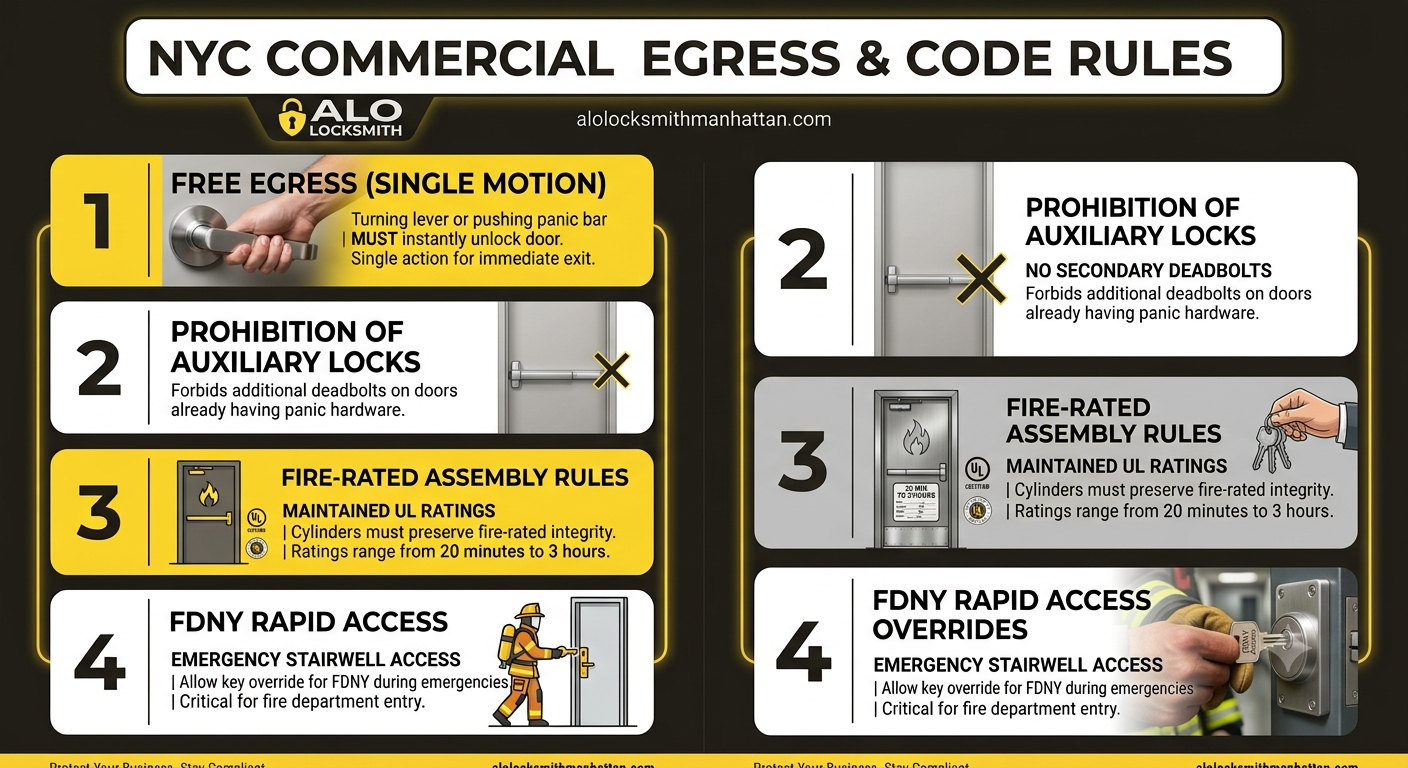
- Free Egress Compliance: Under NYC Building Code Section 1010.1.9 regulations, doors serving as required means of egress must allow occupants to exit freely from the inside without requiring a key, special tool, or specialized knowledge. Master keying applies strictly to the exterior access side of the door; the interior side must unlatch via a single continuous motion, such as pressing a panic bar or depressing a lever handle.
- Prohibition of Secondary Locking Devices: Under FDNY Fire Code mandates, installing secondary surface deadbolts, padlocks, or drop bars on doors equipped with panic hardware is strictly illegal. The primary master-keyed lockset must handle both operational security and egress compliance.
- Fire-Rated Door Assembly Integrity: In compliance with NFPA 80 Standards for Fire Doors and Other Opening Protectives, fire-rated door assemblies (rated from 20 minutes to 3 hours) in Midtown office buildings must remain self-closing and self-latching. Re-pinning or installing master key cylinders inside commercial mortise locksets must maintain the assembly’s UL fire listing without interfering with the latching mechanism.
- Stairwell Re-entry Mandates: High-rise commercial buildings in Manhattan must comply with strict stairwell re-entry laws. During a fire alarm event, electric fail-safe locks or master-keyed mechanical overrides must permit re-entry from stairwells back onto building floors, ensuring occupants are not trapped in smoke-filled stairwells.
During an FDNY life safety inspection at a high-rise office complex near Hudson Yards, building management faced severe fire code violations because a previous tenant had installed manual secondary deadbolts on fire stairwell doors. Our master locksmiths resolved the violation by removing the illegal surface deadbolts, patching the door leaves with fire-rated steel plates, and retrofitting UL-listed electrified mortise locksets tied into the building’s fire alarm system. We integrated the exterior key overrides into the property’s master key matrix, ensuring full FDNY stairwell re-entry compliance while preserving seamless single-key access for facility engineers.
Step-by-Step Installation Process for Midtown Commercial Properties
Engineering and deploying a commercial master key system in Midtown Manhattan requires a structured multi-phase execution process:
- Phase 1: On-Site Audit & Door Schedule Mapping
Our locksmith engineers perform a floor-by-floor site audit. We document every opening in a detailed door schedule that records frame types, existing lock manufacturers (e.g., Schlage mortise vs. BEST SFIC), required access hierarchy levels, and hardware functions. - Phase 2: Key Matrix & Bitting Progression Design
Using proprietary key management software, we calculate the mathematical bitting progression. The software generates non-interfering key codes across all access tiers (GGMK, GMK, MK, Change Keys), enforcing MACS rules and eliminating cross-keying risks. - Phase 3: Bench Assembly & Precision Code-Cutting
Cylinders are pinned on our dedicated assembly benches. Technicians load precise master wafers, bottom pins, and top springs into each core according to the master keying chart. Key blanks are cut on automated code-cutting machines to original manufacturer tolerances (within 0.001 inch) rather than copied from existing keys. - Phase 4: Field Deployment & Operational Testing
Our field installation team replaces or re-pins lock cylinders across the facility. We verify that mortise cylinders, rim cylinders on panic hardware, and cylindrical lever sets operate smoothly. Every key level is field-tested on every assigned door to guarantee smooth operation without binding. - Phase 5: Key Control Register & Signatory Protocols
We deliver the completed system alongside a key control register. Keys are stamped with non-descriptive identification codes (e.g., AA1, AA2) rather than room numbers to prevent security compromises if a key is lost. Authorized client representatives sign official registry documentation establishing control for future key duplication orders.
Cost Factors & Maintenance of Commercial Master Key Systems
Investing in a commercial master key installation involves weighing initial deployment costs against long-term maintenance efficiencies.
Investment & Cost Dynamics
- Cylinder Quantity: Overall pricing scales based on the total number of lock cores being re-pinned or replaced across the facility.
- Core Type & Hardware Grade: Standard commercial core rekeying ranges from 45 USD to 95 USD per cylinder. Upgrading to high-security patented restricted keyway systems (such as Medeco X4 or Schlage Primus) ranges from 125 USD to 250 USD per cylinder, but provides complete anti-duplication protection and pick resistance.
- Hardware Compatibility: If existing door hardware consists of high-quality Grade 1 commercial mortise or cylindrical locksets, our team can re-pin existing cylinders into the new system without requiring full outer hardware replacement.
- Matrix Complexity: Multi-tiered access systems (such as Great Grand Master hierarchies covering multi-floor facilities) require complex mathematical design, capacity planning, and system charting.
System Maintenance & Core Management
Commercial tenants frequently undergo office reconfigurations, personnel changes, and expansions. Maintaining the integrity of a master key system over time requires strict operational management:
- Enforce Restricted Key Control: Maintain exclusive authorization protocols so employees cannot duplicate keys at local hardware stores or kiosks.
- Utilize Interchangeable Cores (IC): Installing SFIC or LFIC cylinders enables facility managers to rekey compromised doors in seconds. Inserting a specialized Control Key allows the core to be extracted and replaced with a newly pinned core immediately.
- Secure Record Archiving: We store master keying charts in secure databases. When an individual change key is lost, our locksmiths re-pin only the specific cylinder affected, preserving the overarching master key hierarchy without necessitating a full facility rekey.
Frequently Asked Questions
What is the difference between a master key system and rekeying existing locks?
Rekeying changes the internal pin configuration of a single lock cylinder so old keys no longer operate it, replacing them with a single new key. A master key system modifies multiple lock cylinders using master wafers so that each lock opens with its own individual change key while a master key opens all locks across the entire system hierarchy.
Can existing commercial lock hardware in Midtown offices be converted into a master key system?
Yes. If existing door hardware consists of standard commercial pin-tumbler cylinders or interchangeable cores from major manufacturers such as Schlage, Medeco, Corbin Russwin, or BEST, our locksmiths can re-pin the existing cylinders to fit a newly engineered master key matrix without requiring complete lockset replacements.
How do restricted keyways prevent unapproved key duplication?
Restricted keyways utilize key blank designs protected by federal utility patents. These key blanks are not distributed to retail stores or automatic key kiosks. Only designated account signatories registered with our locksmith company can order duplicate keys upon presenting official photo identification and signature authorization.
What happens if a Great Grand Master Key is lost or compromised?
If a top-tier master key is lost, systems built with Interchangeable Cores (IC) allow us to rapidly swap cores across affected doors. Because the master key schematic is securely archived on file, our engineers calculate a new master bitting progression, re-pin upper-level core shear lines, and issue new master keys without replacing outer lock hardware.
Are master key systems compliant with NYC Fire Department (FDNY) panic hardware regulations?
Yes, provided the lock cylinder is installed on the exterior entry side of the door. Under NYC Building Code Chapter 10 and FDNY life safety regulations, the interior side of egress doors must always permit immediate, single-motion exit without keys or tools. The master key cylinder controls exterior entry while leaving interior panic exit hardware fully operational.
Sources
- ICC Digital Codes: 2022 New York City Building Code, Chapter 10 Means of Egress (Section 1010.1.9 Door Operations) – https://codes.iccsafe.org/content/NYNYCBC2022P1
- National Fire Protection Association: NFPA 80 Standard for Fire Doors and Other Opening Protectives – https://www.nfpa.org/codes-and-standards/nfpa-80-standard-development
- InstaKey Security Systems: Restricted Keyways & Key Control Standards – https://www.instakey.com/what-we-do/restricted-keyways
