
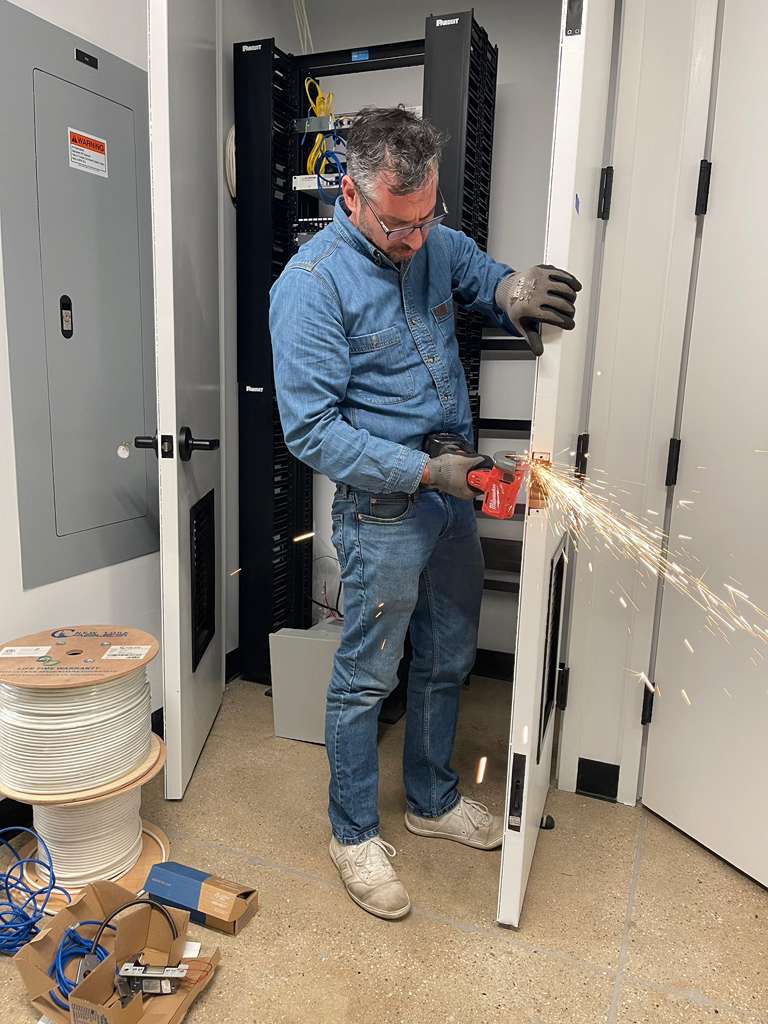
What NYC Business Owners & Property Managers Must Know Right Now
Commercial door hardware in New York City must comply with a layered set of codes enforced by the Fire Department of New York (FDNY), the Department of Buildings (DOB), and national standards incorporated by reference — primarily NFPA 80, NFPA 101, and the International Building Code (IBC) with NYC amendments. The core requirements are: fire-rated doors must be self-closing and self-latching; exit doors serving spaces with an occupant load of 50 or more people must have panic hardware (crash bars); all exit doors must allow free egress without keys, special knowledge, or tight grasping; electromagnetic locks must release instantly upon fire alarm activation or power loss; fire doors must be inspected and tested at least once every 12 months under NFPA 80; and roll-down security gates must meet Local Law 75 transparency requirements by July 1, 2026. Non-compliance triggers fines that range from 800 dollars to 5,000 dollars per violation, forced hardware replacement, and potential business shutdown.
Table of Contents
1. Introduction: Why NYC Door Hardware Codes Are Unlike Anywhere Else
New York City operates under one of the most rigorous fire and life-safety regulatory frameworks in the United States. The FDNY does not merely suggest compliance — it mandates it through the NYC Fire Code (2022 Edition, effective April 15, 2022), the NYC Building Code, and referenced NFPA standards. Business owners, facility managers, and commercial landlords face a dual challenge: securing their property against unauthorized entry while guaranteeing that every occupant can exit immediately and without obstruction during an emergency.
This guide strips away the legal jargon and delivers the actionable requirements you need to make your commercial door hardware inspection-ready. Whether you manage a retail storefront, an office building, a restaurant, or a mixed-use property, the rules explained here apply directly to your doors.
2. The Regulatory Stack: Who Governs What
Understanding which authority controls which aspect of your door hardware is the first step toward compliance.
| Regulatory Body / Standard | Primary Area of Governance | Key Reference |
|---|---|---|
| FDNY (NYC Fire Code) | Fire safety, egress, inspections, violations | NYC Fire Code (2022) |
| NYC Department of Buildings (DOB) | Construction, alterations, permits, building code | NYC Building Code |
| NFPA 80 | Fire door installation, inspection, maintenance | Standard for Fire Doors |
| NFPA 101 (Life Safety Code) | Occupancy classification, egress, panic hardware | Life Safety Code |
| IBC (as amended by NYC) | Door sizes, hardware types, fire/egress routes | NYC Building Code |
| ADA / ICC A117.1 | Accessibility — clear width, opening force, operable hardware | Federal & NYC accessibility law |
In practice, the FDNY enforces what the DOB and national standards require, and a failed FDNY inspection can result in a Notice of Violation that must be corrected — often within 30 days — or escalate to a summons with penalties reaching 5,000 dollars.
3. Fire-Rated Doors: The Foundation of Passive Fire Protection
A fire-rated door is not merely a heavier slab; it is a listed assembly consisting of the door leaf, frame, hardware, glazing, gasketing, closer, and anchorage — all of which must carry a matching fire-protection rating label.
3.1 Fire Ratings and Where They Apply
| Rating | Typical Application |
|---|---|
| 20-minute | Residential corridors, some apartment entry doors |
| 45-minute | Residential stairwells, some mixed-use corridors |
| 60-minute | Commercial stairwells, occupancy separations |
| 90-minute | High-rise shafts, hazardous areas, rated walls |
| 180-minute | Specialized high-hazard enclosures |
NYC buildings use 20- to 90-minute rated doors in residential and commercial settings depending on the wall rating and location within the means of egress.
3.2 Self-Closing and Self-Latching: The Non-Negotiable Rule
Every fire-rated door in NYC must close and latch by itself every single time it is opened. This requirement originates from the NYC Building Code and is cross-referenced in the Fire Code and NFPA 80. A door that is propped open with a wedge, a kick-down holder, or a non-listed hold-open device is an immediate violation. The FDNY commissioner’s message is unambiguous: “Close the door.”
-
Self-closing devices (door closers) must return the door from any open position to the fully closed and latched position without manual assistance.
-
Self-latching hardware must engage automatically when the door reaches the closed position; a door you can pull open without operating the lever or panic bar has failed.
3.3 NFPA 80 Clearance Tolerances (2026 Edition)
The NFPA 80 2026 Edition introduces tighter enforcement of installation clearances to control smoke leakage — smoke, not flame, is the leading cause of fire deaths.
| Location | Maximum Clearance (Fire-Rated) |
|---|---|
| Hinge side, lock side, head | 1/8 inch (0.125 in) |
| Bottom of door | 3/4 inch (0.75 in) standard; 3/8 inch for smoke-rated |
Measure at three points along each edge. Any gap exceeding these tolerances must be corrected before an inspection.
3.4 Annual Fire Door Inspections Are Mandatory
NFPA 80 requires that every fire door assembly be inspected and tested not less than annually, with a written record maintained for review by the authority having jurisdiction (AHJ). NYC fire door inspectors check for:
-
Door label legibility (not painted over)
-
Proper clearances on all sides
-
Functioning self-closing and self-latching operation
-
No unauthorized field modifications (drilled holes, added hardware)
-
Intact intumescent seals and smoke gasketing
-
Properly listed and labeled hardware throughout the assembly
4. Panic Hardware & Exit Devices: When They Are Required
Panic hardware — the horizontal push bar that releases the latch — is mandated by the IBC and NFPA 101 for doors serving spaces with specific occupancy thresholds.
4.1 Occupancy Triggers
| Occupancy Classification | Panic Hardware Required When Occupant Load Is |
|---|---|
| Assembly (Group A) | 50 or more persons |
| Educational (Group E) | 50 or more persons |
| High Hazard (Group H) | Any occupant load |
| Certain other occupancies | Per IBC Chapter 10 / NYC amendments |
4.2 Dimensional and Force Requirements
| Specification | Requirement |
|---|---|
| Mounting height | 34 to 48 inches above finished floor |
| Bar length | At least 50% of door leaf width |
| Actuation force | 15 pounds-force (lbf) maximum |
| Operation | No tight grasping, pinching, or twisting permitted |
4.3 Fire Exit Hardware vs. Standard Panic Hardware
A critical distinction: standard panic hardware is not acceptable on a fire-rated door. Fire-rated doors require UL-listed Fire Exit Hardware — devices that have been tested to remain operable under extreme heat conditions. Installing non-rated panic hardware on a fire door voids the fire rating and will fail inspection.
4.4 The Prohibition on Secondary Locks
You may never install a deadbolt, chain, slide bolt, or any additional locking device on a door equipped with panic hardware. This includes locking the door after hours from the inside. The panic bar must serve as the sole latching mechanism on the egress side.
5. Free Egress: The Golden Rule of Life Safety
The single most important principle in NYC life-safety code is free egress: any person inside a building must be able to exit without special knowledge, special effort, or the use of keys or tools.
5.1 What “Special Knowledge” Means in Practice
-
You cannot require an employee to swipe a badge to exit an office suite (“read-out” configuration).
-
You cannot require a code to be entered on a keypad to leave.
-
You cannot place a sign that says “Use Other Door” as a substitute for a functional exit door.
For 99 percent of NYC commercial occupancies, a single motion — push the bar, turn the lever — must open the exit door.
6. Electrified Hardware: Magnetic Locks, Electric Strikes & Fire Alarm Integration
When access control meets fire code, the compliance stakes rise sharply.
6.1 Electric Strikes (Fail-Secure)
An electric strike replaces the strike plate in the door frame. When power is applied, the strike releases to allow entry from the outside; but from the inside, the mechanical lever or panic bar always works. This inherently satisfies free egress and is the lower-risk compliance option.
6.2 Magnetic Locks (Fail-Safe — With Conditions)
A magnetic lock (maglock) uses an electromagnet to hold the door closed. Because there is no mechanical latch, if power is maintained, the door cannot be pushed open. For this reason, NYC code classifies maglocks as a Special Locking Arrangement and imposes three mandatory layers of release:
-
Request-to-Exit (REX) motion sensor: Detects a person approaching the door and cuts power to the magnet automatically.
-
Push-to-Exit button: A clearly labeled button (typically green) that cuts power for 30 seconds, mounted within 5 feet of the door and functioning independently of the access control system.
-
Fire alarm interface: The maglock power supply must be hardwired to the building fire alarm panel. Activation of the fire alarm — by smoke detector, sprinkler flow switch, or heat detector — must immediately cut power to every maglock on the circuit so that all doors unlock simultaneously.
6.3 Common Maglock Violations the FDNY Flags
| Violation | Why It Fails |
|---|---|
| Maglock without motion sensor | Occupant must find and push a button to exit — violates free egress |
| Battery backup on maglock without fire tie-in | Door stays locked during a power outage even if a fire occurs |
| Painted-over REX sensor | Sensor cannot detect motion, door will not release automatically |
| “Reader In / Reader Out” on a fire-rated exit | Requiring a badge to exit a floor violates free egress unless a formal variance is obtained |
7. Roll-Down Security Gates: Local Law 75 — July 1, 2026 Deadline
If your commercial storefront uses a metal roll-down security gate, you must be aware of Local Law 75 of 2009, which reaches its final enforcement deadline on July 1, 2026.
7.1 The Requirement
All existing and new security grilles installed at businesses classified in Occupancy Groups B (Business) or M (Mercantile) must provide at least 70 percent visibility from the sidewalk. Solid metal gates that obscure the storefront interior are no longer compliant. Non-compliance can result in violations and fines.
7.2 Current Status (May 2026)
As of May 2026, the New York City Council has introduced legislation to amend Local Law 75, and the Department of Buildings has announced a temporary pause on enforcement while the legislative process unfolds. However, the law has not been repealed. Business owners should continue preparing for compliance until a formal legislative change is enacted.
8. ADA Accessibility Requirements for Commercial Door Hardware
The Americans with Disabilities Act (ADA) and ICC A117.1 impose requirements that intersect with fire code compliance. A door can satisfy fire safety rules yet still violate accessibility standards.
| Parameter | Requirement |
|---|---|
| Clear opening width | Minimum 32 inches when door is open 90 degrees |
| Opening force (interior non-fire doors) | 5 pounds-force maximum |
| Opening force (exterior doors) | 8.5 pounds-force maximum |
| Operable hardware | One-hand operation, no tight grasping, pinching, or twisting |
| Hardware mounting height | 34 to 48 inches above finished floor |
| Closing speed | Adjusted so door does not slam on a person moving slowly |
9. Hardware Grades, Listings, and Certification Marks
9.1 ANSI/BHMA Grades
| Grade | Cycle Rating | Recommended Application |
|---|---|---|
| Grade 1 | 800,000+ cycles | High-traffic commercial entrances, stairwells |
| Grade 2 | 400,000 cycles | Moderate-traffic office doors |
| Grade 3 | 200,000 cycles | Residential use only — not permitted in commercial settings |
For any NYC commercial door that sees daily use, specify Grade 1 hardware. The upfront cost difference is negligible compared to the cost of replacing a failed lockset and correcting a violation.
9.2 UL Listings
Underwriters Laboratories (UL) certification is the primary evidence that hardware has been tested to the relevant fire and safety standards. Look for the UL mark on the latch plate, door label, and frame label. Uncertified hardware on a fire-rated door is an immediate inspection failure.
10. Common FDNY Violations and How to Avoid Them
| Violation | Corrective Action |
|---|---|
| Fire door propped open with a wedge | Remove wedge; verify closer functions; install listed hold-open device tied to fire alarm if door must stay open |
| Missing or painted-over fire door label | Replace door or have label reissued by a certified inspection agency |
| Deadbolt added to panic-hardware door | Remove deadbolt; fill holes with listed materials; restore door to panic-bar-only operation |
| Door closer removed or disconnected | Reinstall and adjust closer; test self-closing and self-latching from 90 degrees and 30 degrees |
| Excessive perimeter clearances | Adjust hinges, replace gasketing, or re-hang door to meet NFPA 80 tolerances |
| Maglock without fire alarm tie-in | Hardwire lock power supply to fire alarm panel with a listed relay interface |
| Blocked egress path (storage, displays) | Clear all obstructions from the exit path and maintain a 36-inch minimum clear width |
| Roll-down gate below 70% transparency | Replace gate with compliant open-grid model before enforcement deadline |
11. Inspection Readiness: A Practical Compliance Checklist
Monthly (Self-Inspection by Staff)
-
Test every panic bar with a light push — door must open immediately.
-
Listen to door closers — door must close smoothly and latch without slamming.
-
Inspect perimeter seals — no visible light gaps around the door edges.
-
Verify exit paths are unobstructed and exit signs are illuminated.
-
Check that no secondary locks (chains, deadbolts) have been added to exit doors.
Annually (Professional Fire Door Inspection per NFPA 80)
-
Certified inspector checks all labeled fire doors, frames, and hardware.
-
Clearances measured and documented.
-
Door closers, coordinators, and hold-open devices tested.
-
Written inspection report maintained on-site for FDNY review.
12. Why Professional Installation and Maintenance Is Not Optional
NYC door hardware compliance is not a do-it-yourself project. A significant alteration to door hardware — particularly in a Class E (commercial office) occupancy or a landmarked building — may require DOB filing or FDNY review. Drilling a new hole in a fire-rated door without a listed preparation procedure voids the fire label. Installing a maglock without proper fire alarm integration creates a life-safety hazard that can result in criminal liability if an injury or death occurs.
A qualified commercial locksmith familiar with NYC codes will:
-
Select hardware with the correct fire rating and UL listing
-
Install to NFPA 80 clearance tolerances
-
Integrate electrified hardware with the building fire alarm system
-
Provide documentation for DOB and FDNY inspections
-
Conduct annual fire door inspections and maintain written records
13. How ALO Locksmith Services Manhattan NYC Keeps Your Business Compliant
When your commercial doors must satisfy FDNY fire code, DOB building code, and ADA accessibility standards, you need a locksmith partner who understands the regulatory landscape and executes with precision. ALO Locksmith Services Manhattan NYC has over 15 years of hands-on experience securing businesses across Manhattan and the five boroughs. Our commercial locksmith team handles:
-
Fire door hardware installation and repair: We install and maintain self-closing, self-latching hardware that meets NFPA 80 and NYC Fire Code requirements.
-
Panic bar and exit device compliance: From single-door push bars to vertical rod systems on double doors, we ensure your exits meet occupancy and force requirements.
-
Access control integration with fire alarm systems: We wire maglocks, electric strikes, and delayed egress systems to your building fire panel so doors fail-safe during an emergency.
-
Local Law 75 roll-down gate evaluation and replacement: We assess your storefront security gates and provide compliant solutions ahead of the 2026 enforcement deadline.
-
Annual fire door inspections: Our certified technicians perform NFPA 80-compliant inspections and provide the written documentation the FDNY requires.
-
Emergency commercial lock repair: When a door closer fails, a panic bar sticks, or a fire door won’t latch, we respond fast — 24/7, across Manhattan.
We serve retail stores, restaurants, office buildings, medical facilities, educational institutions, and multi-tenant commercial properties. Every job starts with a transparent, upfront quote. No hidden costs, no surprises.
Call ALO Locksmith Manhattan at (212) 555-0189 or visit our website at alolocksmithmanhattan.com to schedule a commercial door hardware compliance assessment.
14. Frequently Asked Questions
Do all commercial doors in NYC need to be fire-rated?
No. Only doors located in fire-rated walls — such as stairwells, corridors separating occupancy types, and certain shaft enclosures — are required to be fire-rated. A qualified locksmith or code consultant can determine which of your doors fall under this requirement.
Can I install a deadbolt on my storefront door for extra security at night?
You may install a deadbolt on a non-exit storefront door. However, if the door is a designated emergency exit, you must never add a secondary lock that impedes egress. Deadbolts on panic-bar-equipped doors are a code violation.
How much does an FDNY fire door violation cost?
FDNY fines range from 800 dollars for minor violations to 5,000 dollars or more for serious life-safety infractions. Repeat violations and failure to correct within the specified timeframe can escalate to criminal summonses and business closure.
What is the difference between fail-safe and fail-secure?
Fail-safe means the door unlocks when power is lost (required for maglocks on egress paths). Fail-secure means the door remains locked from the outside when power is lost, but you can still exit from the inside mechanically (typical for electric strikes). The choice depends on the door’s location and function within the egress plan.
Does the July 1, 2026 Local Law 75 roll-down gate deadline still apply?
As of May 2026, enforcement has been temporarily paused pending proposed legislation. However, the law has not been repealed. Business owners should continue preparing for compliance and monitor official DOB and FDNY announcements for final guidance.
Sources
-
NYC Fire Code (2022 Edition), Local Law No. 47 of 2022
-
NFPA 80, Standard for Fire Doors and Other Opening Protectives (2026 Edition)
-
NFPA 101, Life Safety Code
-
NYC Building Code, Chapter 7, Fire and Smoke Protection Features
-
NYC Administrative Code, Section 28-315.10, Self-Closing and Self-Latching Devices
-
Local Law 75 of 2009, Roll-Down Security Grille Visibility Standards
-
International Building Code (IBC), Chapter 10, Means of Egress
-
ADA Standards for Accessible Design / ICC A117.1
-
NYC Department of Buildings, Door Safety and Building Code Overview
-
FDNY Business Inspections Guide
-
FDNY Violations, Fines, and Compliance Deadlines
-
National Fire Protection Association, Code Commentary on Safety and Security
Related Articles
Panic Bar Installation For Manhattan Retail Spaces: NYC Fire Code Edition
Identify, Secure & Upgrade Pre-War Apartment Locks in NYC: Expert Guide from ALO Locksmith Manhattan
People Also Ask
No, not all doors in a commercial building are required to be fire doors. Fire doors are specifically mandated by the NYC Fire Code for openings in fire-rated walls, stairwell enclosures, and corridors that serve as a means of egress. Their primary purpose is to contain smoke and flames, allowing safe evacuation. For general interior doors, such as those for private offices or storage closets without a fire-rating requirement, standard commercial doors are acceptable. However, every commercial building must comply with strict local regulations. For expert guidance on meeting these codes, especially for retail spaces, we recommend reading our internal article titled Panic Bar Installation For Manhattan Retail Spaces: NYC Fire Code Edition. ALO Locksmith Services Manhattan NYC can help assess your specific door requirements to ensure full compliance.
Section 908.10 of the New York City Building Code addresses the requirement for key boxes on certain commercial and multi-family buildings. Specifically, it mandates that a secure key box, approved by the fire department, be installed at a location accessible to emergency responders. This ensures that firefighters and other first responders can quickly gain entry to a building during an emergency without causing damage. The key box must contain keys for all locked areas of the property, including common entrances and mechanical rooms. For property owners in Manhattan, ensuring compliance with this code is essential for safety and legal operation. ALO Locksmith Services Manhattan NYC can assist with selecting and installing approved key boxes that meet these strict municipal requirements.
The code 10-75 is a high-level alarm designation used by the FDNY (Fire Department of New York) to indicate a working fire that requires a significant response of resources. It typically means that a fire has been confirmed and additional units, including ladder companies, engine companies, and support vehicles, are dispatched to the scene. This code helps coordinate emergency efforts efficiently. For property owners in Manhattan, understanding such codes can be useful when interacting with fire safety professionals. If you need assistance with fire-rated locks or emergency exit hardware that meets FDNY regulations, ALO Locksmith Services Manhattan NYC can provide expert guidance and installation services to ensure your property complies with local safety standards.
The sequence "5 5 5 5" is not a standard code used by the Fire Department of New York (FDNY) for general public communication. In FDNY radio and dispatch protocols, specific number sequences often refer to alarm levels, box numbers, or unit designations. For example, a "5-5-5-5" might be a misheard or informal reference to a "10-75" signal, which indicates a working fire, or it could relate to a specific building or location code. Without official FDNY documentation confirming this exact sequence, it is likely a colloquialism or error. For accurate interpretation, you should consult FDNY official training materials or a certified professional. If you need secure access or lockout assistance related to FDNY facilities in Manhattan, ALO Locksmith Services Manhattan NYC can provide reliable service.
The New York City Fire Code of 2014 sets strict regulations for commercial buildings, including requirements for panic hardware on egress doors in retail spaces. This code mandates that any door serving an occupancy load of 50 or more must be equipped with panic bars that release with a single motion, ensuring swift evacuation during emergencies. Compliance is critical to avoid fines and ensure public safety. For specific guidance on meeting these standards, refer to our internal article titled Panic Bar Installation For Manhattan Retail Spaces: NYC Fire Code Edition, which details installation best practices for Manhattan retail environments. ALO Locksmith Services Manhattan NYC recommends consulting a licensed professional to verify your setup aligns with current NYC Fire Code amendments.
The New York City Fire Code Chapter 9 specifically governs the requirements for means of egress, including the installation and maintenance of panic hardware. For retail spaces in Manhattan, this chapter mandates that any door serving an occupant load of 50 or more must be equipped with a panic bar that releases with a single motion. Compliance is critical to avoid fines and ensure public safety. For detailed guidance on meeting these standards, refer to our internal article titled Panic Bar Installation For Manhattan Retail Spaces: NYC Fire Code Edition. ALO Locksmith Services Manhattan NYC recommends scheduling regular inspections to verify that all hardware functions correctly under NYC regulations.
