
Reinforcing Upper West Side Entryways with High-Security Deadbolts
We install Grade 1 Medeco deadbolts anchored into primary structural framing across Upper West Side entryways to solve severe mechanical vulnerabilities in historic prewar timber, brownstone double doors, and mineral-core steel doors. Standard Grade 3 hardware fails under direct physical force, whereas engineered Grade 1 installations reinforce structural wood leaves and fire-rated frames against kick-ins.
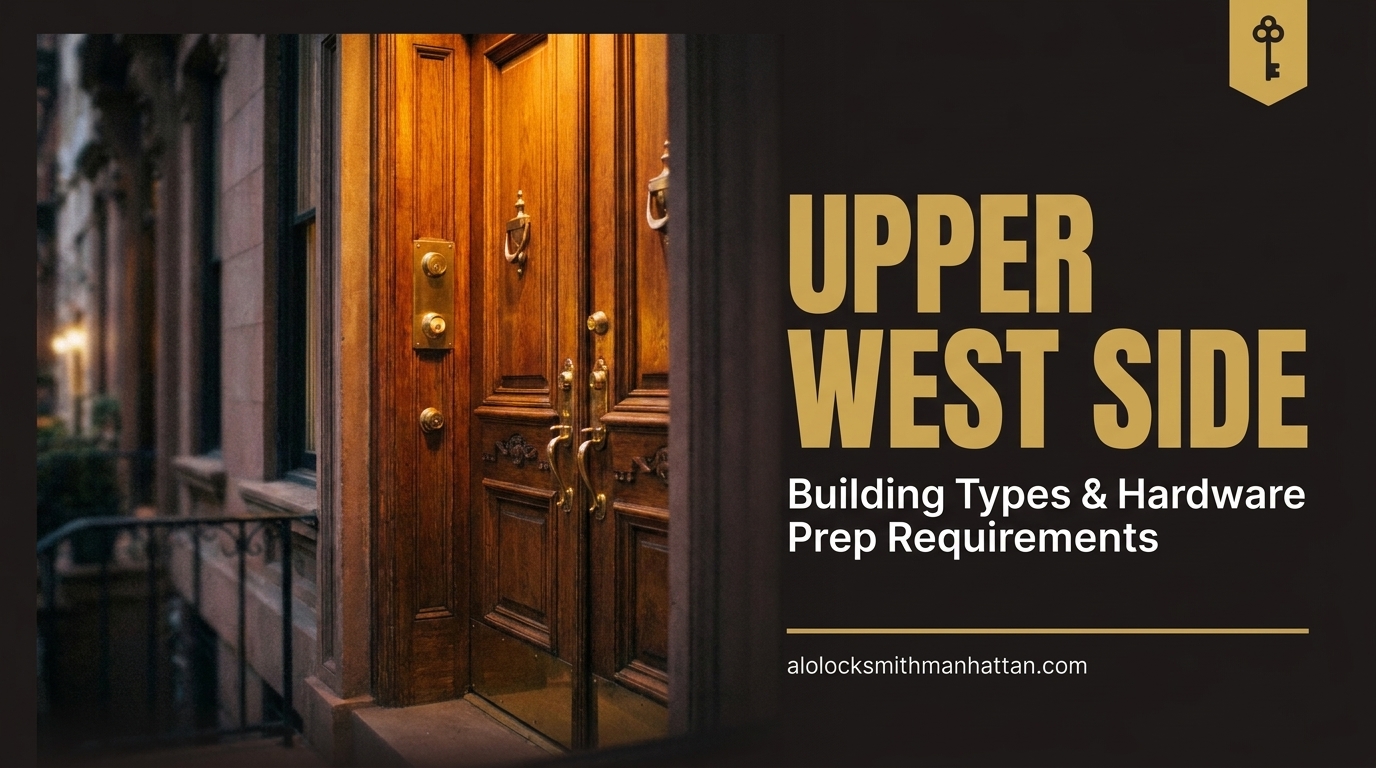
In prewar residential co-ops along Central Park West and Riverside Drive, original entry doors measure between 1.75 inches and 2.25 inches thick, constructed from aged mahogany or solid oak. Drilling into these delicate wood leaves without specialized guide jigs splits historic moulding and compromises structural integrity. Standard short-latch deadbolts caught only in thin wood trim remain highly susceptible to frame-splitting kick-in attacks during violent break-in attempts.
Postwar high-rise apartment buildings along Broadway and Amsterdam Avenue utilize hollow metal doors packed with thermal mineral cores. Cutting into these steel skins improperly voids mandatory fire-resistance ratings governed by municipal safety standards. Generic retail locks lack the structural steel mounting sleeves needed to keep mineral-core doors intact during physical impacts or structural fire stress.
- Prewar Solid Wood Doors: Aged timber requires custom mortise extensions and precision jigs to prevent splitting decorative paneling.
- Historic Townhouse Entrances: Double doors demand heavy-duty strike box anchoring directly into internal masonry to prevent frame splitting.
- Postwar Hollow Metal Doors: Steel skins require UL 10C and UL 437 rated hardware to preserve fire door integrity and resist door-buckling forces.
Medeco Maxum Technical Capabilities and Physical Defense Engineering
We specify Medeco 4 and Medeco3 Maxum deadbolts for Manhattan properties because their patented rotating pin tumbler mechanics, UL 437 drill-resistant hardened steel inserts, and free-spinning solid brass collars deliver uncompromising physical defense. These integrated components render the lock immune to picking, bumping, core pulling, and pipe wrench attacks during high-force burglary attempts.
The inner locking cylinder functions using elevated, rotating pin tumblers paired with a specialized side-pin locking bar mechanism. The key cut must simultaneously lift and rotate every pin to precise angles before the sidebar drops, making bump key methods completely ineffective. Hardened steel crescent inserts inside the cylinder face ruin high-speed drill bits before they penetrate internal spring pins.
A free-spinning solid brass collar surrounds the exterior cylinder face to neutralize destructive twisting attacks. When an intruder attempts to grab the outer lock housing with heavy pliers or a pipe wrench, the collar rotates freely without transmitting torque to internal retaining bolts. A solid 1-inch hardened steel bolt encased in heavy-gauge steel housing prevents crowbar prying and hacksaw breaches.
- Rotating Pin Tumbler Mechanism: Dual-locking sidebar design prevents picking and bump key attacks.
- Hardened Steel Crescent Inserts: Shields internal cylinder components from high-speed drill destruction.
- Free-Spinning Brass Collar: Neutralizes pipe wrench torsion and channel-lock twisting attempts.
- Solid Steel Bolt and Shroud: Resists physical prying and metal saw attacks.
Technical Comparison: Medeco Maxum vs Standard Locks
We evaluate high-security deadbolt hardware by comparing mechanical load thresholds, key control patents, and fire ratings against standard Grade 2 commercial or Grade 3 residential locks. Grade 1 Medeco Maxum deadbolts outperform alternative locks by providing UL 437 physical attack resistance, high-tensile mounting bolts, and strict key duplication protection.
| Technical Feature | Standard Residential Lock (Grade 3) | Standard Commercial Lock (Grade 2) | Medeco Maxum High-Security Deadbolt (Grade 1) |
|---|---|---|---|
| ANSI/BHMA Rating | ANSI/BHMA A156.36 Grade 3 | ANSI/BHMA A156.36 Grade 2 | ANSI/BHMA A156.30 & A156.36 Grade 1 |
| UL Certification | Unrated or Basic UL 10B | UL 10C Fire Rated | UL 437 Physical Attack & 3-Hour Fire Rated |
| Bolt Construction | Stamped steel or hollow zinc | Solid zinc alloy with 1-inch throw | Hardened solid steel in heavy-gauge housing |
| Mounting Hardware | Light-duty sheet metal screws | Standard steel mounting bolts | 1/4-inch high-tensile steel mounting bolts |
| Outer Collar Shield | Fixed plastic or thin metal | Fixed zinc alloy ring | Free-spinning solid brass collar |
| Keyway Security | Unpatented open keyway | Commercial open keyway | Patented key control (Medeco 4 / Medeco3) |
| Strike Plate Anchoring | 3/4-inch wood screws | 1-inch frame screws | Heavy box strike with 2-inch frame screws |
Standard residential locks cost between 20 US Dollars and 50 US Dollars in initial hardware expense but offer minimal physical resistance against forced entry. Investing 250 US Dollars to 400 US Dollars in Grade 1 Medeco hardware eliminates long-term property liability and stops unauthorized key duplication by contractors or past tenants. If you require maximum physical force resistance and absolute key governance, prioritize Grade 1 Medeco Maxum deadbolts; if you are securing low-risk interior non-egress dividers, standard Grade 2 commercial locks are sufficient.
NYC Building Code and FDNY Free-Egress Compliance
We guarantee full NYC housing code and FDNY egress compliance by exclusively fitting single-cylinder deadbolts equipped with interior thumbturns on primary multi-family entrance doors. Municipal law prohibits double-cylinder key-operated interior locks on residential exit doors, ensuring that occupants retain immediate, single-motion escape capabilities during smoke and fire emergencies without requiring keys.
Under the NYC Department of Housing Preservation and Development (HPD) Housing Maintenance Code Section 27-2043, landlords and co-op owners must install a heavy-duty deadbolt on all dwelling unit entrance doors. The code specifies that the interior deadbolt mechanism must operate via a simple thumbturn rather than a key cylinder. Installing double-cylinder deadbolts that require a key from the inside violates municipal housing laws and creates hazardous exit traps.
The NYC Fire Department enforces mandatory life-safety rules under NYC Fire Code Section 1010.1, requiring single-motion free egress on all primary dwelling exit doors. Lock mechanisms must retract smoothly with one rotational movement without requiring tight wrist twisting or special tools. Property owners can verify lock engineering specifications through technical documentation from Medeco Security Locks and safety standards set by the Builders Hardware Manufacturers Association (BHMA).
- Single-Cylinder Deadbolt Mandate: Interior operation must always utilize an unencumbered thumbturn for immediate emergency escape.
- Illegal Double-Cylinder Locks: Key-operated interior cylinders are strictly prohibited on primary residential exit doors in NYC.
- Single-Motion Egress Requirement: Latch retraction must occur seamlessly with one manual rotation during evacuation.
Real-World Case Examples: Resolving Complex Upper West Side Security Challenges
We engineer custom security retrofits for Upper West Side entryways to resolve severe architectural conflicts, including shifted historic timber frames, oversized prewar doors, and strict co-op board guidelines. By integrating specialized mortise cylinders and structural wall anchor systems, we establish maximum physical protection while preserving historical aesthetics and meeting municipal codes.
Case 1: Prewar Co-Op Historic Door Retrofit on Central Park West
We resolved a critical security conflict for a Central Park West co-op owner who needed high-security key governance on a century-old, 2.25-inch thick mahogany door without altering exterior historic brass trim. Our solution integrated a custom Medeco 4 mortise cylinder into the original cast-iron body, delivering UL 437 drill protection.
The co-op board prohibited drilling new crossbore holes or modifying the original door face. We engineered an extended tailpiece mechanism that mated directly with the historic interior lock body while housing the Medeco 4 cylinder behind the original brass rosette. This approach delivered full pick and drill resistance while maintaining 100 percent historic compliance with co-op architectural mandates.
Case 2: Steel Frame Misalignment and Egress Binding on Riverside Drive
We corrected severe lock binding and frame compromise on a Riverside Drive postwar high-rise steel fire door caused by structural building settling. By realigning the jamb, mortising a heavy-duty steel box strike directly into wall studs, and re-hanging the leaf with continuous hinges, we eliminated frame rattle and restored single-motion egress.
A previous installer had filed down the strike opening, destroying structural integrity and causing the door to fail fire containment seals. We jacked the compressed steel frame back to plumb and anchored a Medeco heavy-duty box strike using 2-inch hardened screws driven straight into structural wall framing. This structural restoration eliminated lock binding and restored smooth thumbturn operation under FDNY single-motion egress standards.
Step-by-Step Professional Medeco Deadbolt Installation Protocol
We execute a five-step mechanical installation protocol to ensure every Medeco Maxum deadbolt meets UL 437 security standards and FDNY emergency egress regulations. Our precise workflow verifies frame plumbness, bores clean cylinder openings, secures quarter-inch mounting bolts, and anchors steel strike plates into structural studs to resist high-impact forces.
- Door Frame Alignment and Backset Inspection: We check frame squareness, door thickness, and backset depth settings at 2.375 inches or 2.75 inches to align hardware components perfectly.
- Core Boring and Edge Mortising: Using specialized steel drilling jigs, we bore the 2.125-inch crossbore and 1-inch edge hole, chiseling the edge flush for faceplate mounting.
- Lock Body and Cylinder Housing Assembly: We insert the Medeco brass cylinder and protective shroud into the crossbore, tightening the assembly with quarter-inch high-tensile steel mounting bolts.
- Heavy-Duty Steel Box Strike Anchoring: We mortise the jamb for the heavy steel box strike and drive 2-inch hardened steel anchor screws directly into structural framing studs.
- Operational Testing and Key Registration: We test interior thumbturn rotation and exterior key turning through multiple mechanical cycles before issuing the official Key Control Registration Card.
Patented Key Control and Restricted Key Duplication Protocols
We establish complete key governance for property owners through Medeco patented key control systems that eliminate unauthorized duplication by building employees, contractors, or subtenants. Federal utility patents restrict key blank distribution exclusively to authorized security dealers, requiring documented owner authorization and official registration cards before any new key can be cut.
Medeco 4 keyways operate under United States utility patent protection extending through the year 2040. Unauthorized manufacturing or copying of these key blanks constitutes federal patent infringement. The specialized key design features angled biting cuts and a sliding contact pin that interacts with internal rotating tumblers, requiring specialized laser-calibrated key machines that hardware kiosks cannot replicate.
Upon completing installation, we hand the property owner a dedicated Medeco Key Authorization Card. To request additional keys, the verified owner must present this card along with government photo identification at our facility. This verified control mechanism ensures that unapproved service workers or departing tenants cannot make hidden copies of apartment keys.
Frequently Asked Questions
Why is the Medeco Maxum deadbolt recommended for Upper West Side apartment doors?
The Medeco Maxum deadbolt is recommended because it provides Grade 1 physical strength and UL 437 drill and pick protection tailored for NYC apartment entryways. Its solid brass collar, 1-inch hardened steel bolt, quarter-inch high-tensile mounting bolts, and restricted keyways defend against physical kick-ins, prying, and key duplication while complying with building codes. We install this deadbolt to ensure absolute physical defense while complying with local building and housing codes.
Are double-cylinder deadbolts legal on apartment doors on the Upper West Side?
No, double-cylinder deadbolts requiring an interior key are illegal on primary apartment entry doors in New York City. The NYC Housing Maintenance Code and FDNY egress rules require single-cylinder deadbolts with interior thumbturns to allow unencumbered evacuation during emergencies. We strictly install code-compliant thumbturn mechanisms to eliminate hazardous exit traps in residential units.
How does Medeco key control prevent unauthorized key copying by building staff or contractors?
Medeco key control prevents unauthorized copying by restricting key blank distribution through federal utility patents. Automated key-cutting kiosks and general hardware stores do not possess Medeco key blanks or specialized angular cutting machinery. Duplicate keys are cut exclusively by authorized dealers who verify the registered owner’s official Key Authorization Card and photo identification.
Can a Medeco high-security cylinder be installed in historic prewar mortise hardware?
Yes, Medeco manufactures high-security mortise cylinders engineered specifically to retrofit into vintage prewar mortise bodies. This specialized fitting allows brownstone residents and prewar co-op owners on the Upper West Side to upgrade to UL 437 pick and drill resistance. We execute these retrofits without altering exterior historic brass hardware or violating strict co-op architectural rules.
How long does a professional Medeco deadbolt installation take?
A standard Medeco deadbolt installation or mortise cylinder retrofit typically takes between 30 and 60 minutes per door. If the door frame requires structural alignment, hinge adjustment, or custom chiseling to anchor the steel box strike into wall studs, installation may take up to 90 minutes. We ensure every job meets full structural stability and local egress compliance.
Sources
- NYC Housing Preservation and Development (HPD) – Housing Maintenance Code Section 27-2043: https://www.nyc.gov/site/hpd/index.page
- NYC Fire Department (FDNY) – Fire Code Means of Egress Regulations Section 1010.1: https://www.nyc.gov/site/fdny/index.page
- Medeco Security Locks – Medeco 4 Maxum High Security Deadbolt Specifications: https://www.medeco.com
- Builders Hardware Manufacturers Association (BHMA) – ANSI/BHMA Grade 1 Standards: https://www.bhma.org
